

When you’re evaluating a significant home improvement, you need to look beyond the initial price tag and focus on the long-term financial return. A solar pool heating system isn’t just an expense; it’s a high-yield investment that delivers tangible, data-driven returns for decades. While the comfort of a warm pool is a luxury, the decision to heat it with solar is a strategic financial move. You may have heard that solar saves you money, but what is the real return on investment (ROI)? How does it stack up against other financial investments, and how quickly can you expect to recoup your initial outlay?
This article provides a comprehensive, data-driven analysis of the real ROI of solar pool heating. We will move beyond marketing claims and dive deep into the numbers, using actual cost data, verifiable case studies, and proven financial metrics. You will learn how to calculate your specific ROI, understand the key variables that impact your savings, and see a clear, 20-year financial forecast that illustrates why solar is not just the most economical way to heat your pool, but also one of the most powerful investments you can make in your home.
Understanding ROI: The Key Financial Metrics for Your Pool Heater
Before we dive into the specific numbers for solar pool heating, it’s crucial to understand the financial metrics that define a good investment. When you evaluate a pool heater, you should be thinking like an investor, not just a consumer. The three most important metrics for this analysis are the Return on Investment (ROI), the Payback Period, and the Total Cost of Ownership (TCO).
Return on Investment (ROI): A Measure of Profitability
ROI is a simple yet powerful formula that measures the profitability of an investment. It calculates the financial gain relative to the initial cost. A higher ROI indicates a more profitable investment.
ROI Formula: (Net Profit / Cost of Investment) x 100 = ROI %
For a solar pool heater, the “Net Profit” is the money you save on energy bills that you would have otherwise spent on a gas or electric heater. As you’ll see, the ROI of a solar pool heater can be astonishingly high, often exceeding the average returns of the stock market
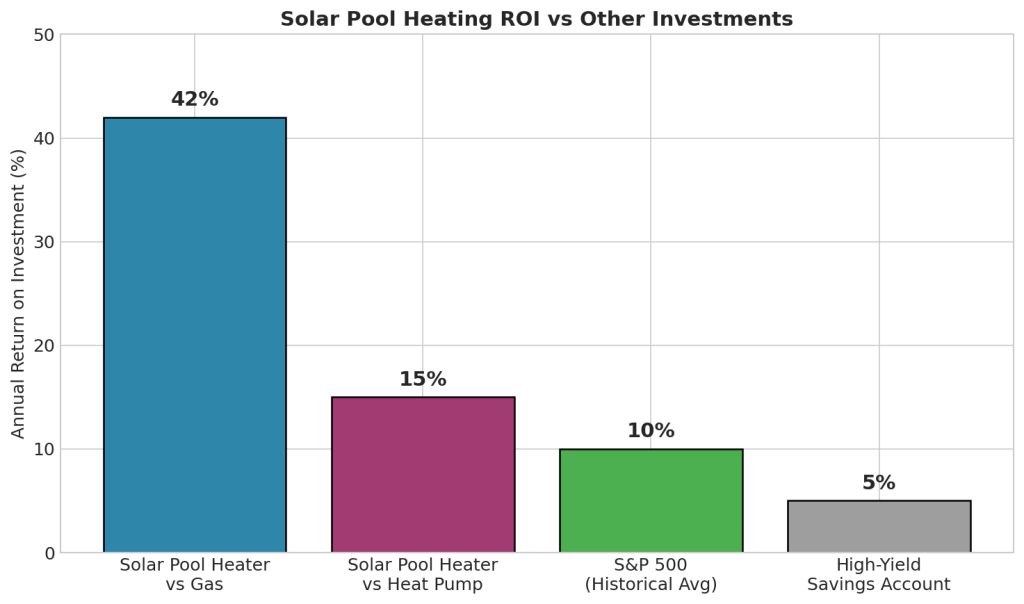
Data Sources: Author’s analysis based on data from multiple sources [1] [2] [3]
As the chart above demonstrates, the annual ROI for a solar pool heater can be as high as 42% when compared to a gas heater. This is a level of return that is virtually unheard of in traditional financial markets, making a solar pool heater not just an energy-saving device, but a powerful financial asset.
Payback Period: How Quickly You Get Your Money Back
The payback period is the length of time it takes for the accumulated savings from an investment to equal the initial cost. A shorter payback period means you start earning a pure profit sooner. For solar pool heaters, the payback period is remarkably short, often between 2 and 7 years.
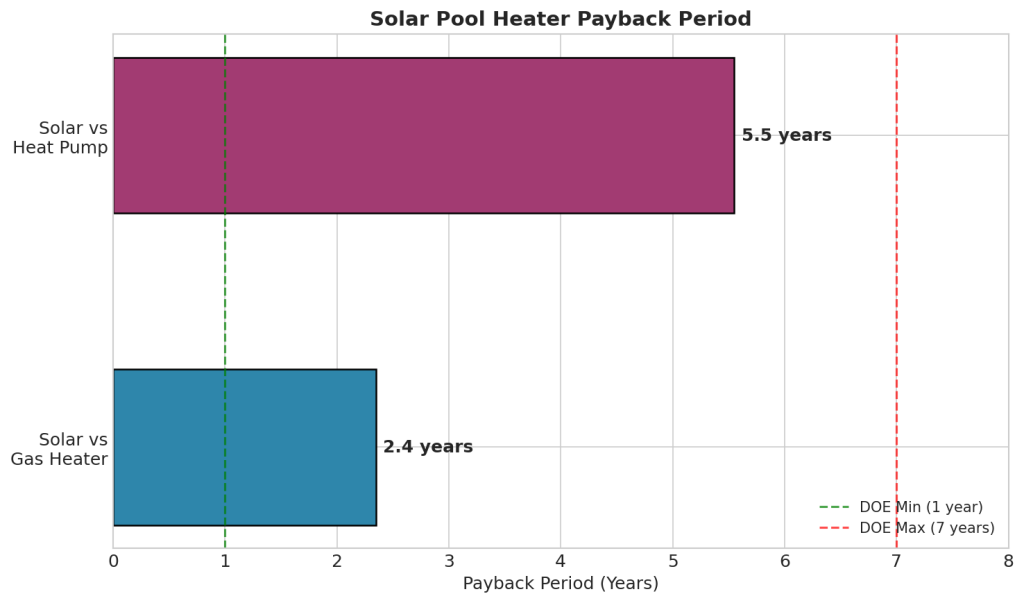
Data Sources: U.S. Department of Energy, LeeFondiller.com [1] [4]
This rapid payback is a key indicator of a strong investment. Once you’ve passed the break-even point, every dollar you save on energy is a direct financial gain for the remaining 15-25 year lifespan of the system.
Total Cost of Ownership (TCO): The True Long-Term Cost
TCO is the most comprehensive metric for evaluating the long-term financial impact of a purchase. It includes not only the initial installation cost but also all the operating and maintenance costs over the asset’s entire lifespan. When you analyze the TCO of different pool heating options, the financial superiority of solar becomes crystal clear.
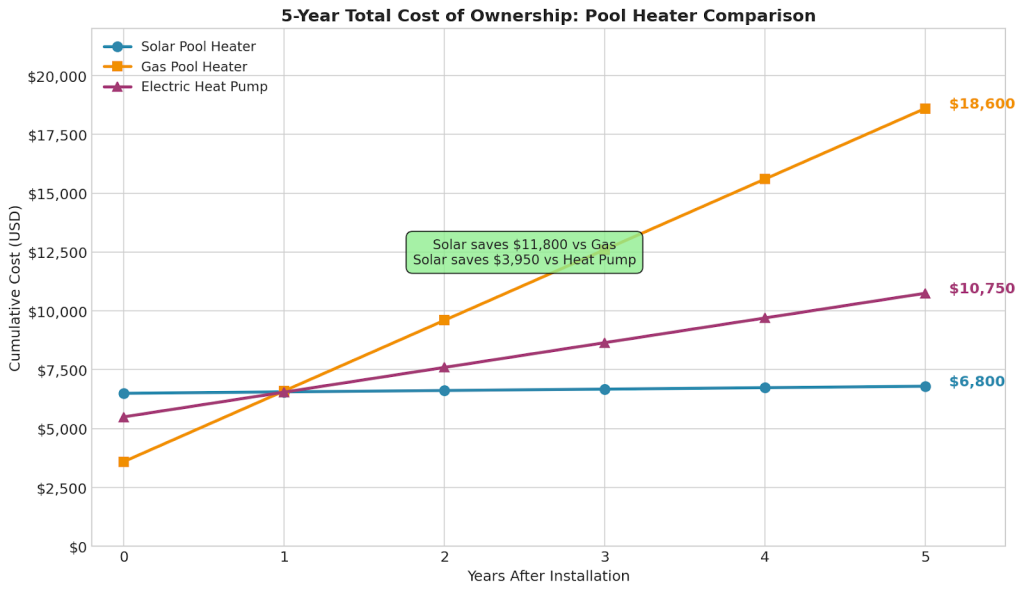
Data Sources: Author’s analysis based on data from multiple sources [1] [2] [3]
While gas heaters may have a lower initial cost, their exorbitant operating costs cause their TCO to skyrocket over time. A solar heater, with its near-zero operating costs, has a much lower TCO, making it the undisputed long-term financial winner.
How to Calculate Your Real ROI: A Step-by-Step Guide
Calculating the precise ROI of a solar pool heating system for your specific situation is a straightforward process. By plugging in your own numbers, you can get a clear picture of the financial benefits you can expect. Let’s walk through the calculation step-by-step, using a real-world example.
Step 1: Determine Your Annual Heating Costs with Your Current or Alternative Heater
First, you need to know how much you are currently spending, or would spend, to heat your pool with a gas or electric heater. You can find this information on your utility bills or use the following estimates:
- Gas Heater: Annual cost can range from $2,400 to $4,200, depending on your climate and local gas prices.
- Electric Heat Pump: Annual cost typically falls between $1,050 and $2,700.
For our example, let’s assume you are using a gas heater and your annual heating cost is $3,000.
Step 2: Determine the Cost of a Solar Pool Heating System
Next, you need to get a quote for a professionally installed solar pool heating system. The cost will vary based on the size of your pool and your location, but a typical range is $4,000 to $9,000. For our example, we will use an installed cost of $6,500.
Step 3: Factor in the Federal Solar Tax Credit
The federal Residential Clean Energy Credit allows you to deduct 30% of the total system cost from your federal income taxes. This is a direct, dollar-for-dollar credit that significantly reduces your net investment.
- Tax Credit: $6,500 (System Cost) x 0.30 = $1,950
- Net Investment: $6,500 – $1,950 = $4,550
Step 4: Calculate Your Annual Savings
Your annual savings are the difference between your old heating costs and the minimal operating cost of the solar system (for the pump), which is typically around $60 per year.
- Annual Savings: $3,000 (Old Cost) – $60 (Solar Cost) = $2,940
Step 5: Calculate the Simple Payback Period
The payback period is your net investment divided by your annual savings.
- Payback Period: $4,550 (Net Investment) / $2,940 (Annual Savings) = 1.55 years
In this example, your solar pool heating system will have paid for itself in just over a year and a half.
Step 6: Calculate the Annual ROI
Your annual ROI is your annual savings divided by your net investment.
- Annual ROI: ($2,940 / $4,550) x 100 = 64.6%
This is an extraordinary return that is virtually impossible to achieve with any other home improvement or traditional financial investment.
| Metric | Calculation | Result |
| System Cost | – | $6,500 |
| Federal Tax Credit (30%) | $6,500 x 0.30 | $1,950 |
| Net Investment | $6,500 – $1,950 | $4,550 |
| Annual Gas Heating Cost | – | $3,000 |
| Annual Solar Operating Cost | – | $60 |
| Annual Savings | $3,000 – $60 | $2,940 |
| Simple Payback Period | $4,550 / $2,940 | 1.55 Years |
| Annual ROI | ($2,940 / $4,550) x 100 | 64.6% |
Table: Sample ROI Calculation for a Solar Pool Heater.
The 20-Year Financial Forecast: A Story of Compounding Returns
To truly grasp the long-term financial power of a solar pool heating investment, you need to look beyond the first few years and project the costs and savings over the full lifespan of the equipment. A 20-year forecast reveals a staggering difference in TCO and highlights the compounding nature of your returns.
The Hidden Costs of Replacements
One of the most overlooked factors in the long-term cost of pool heating is the need to replace less durable equipment. Gas heaters and electric heat pumps have significantly shorter lifespans than solar systems, which means you will likely have to buy them two or even three times over a 20-year period. These replacement costs dramatically increase the TCO of traditional heating methods.
- Gas Heater Lifespan: 5-7 years
- Electric Heat Pump Lifespan: 8-10 years
- Solar Pool Heater Lifespan: 20-30+ years
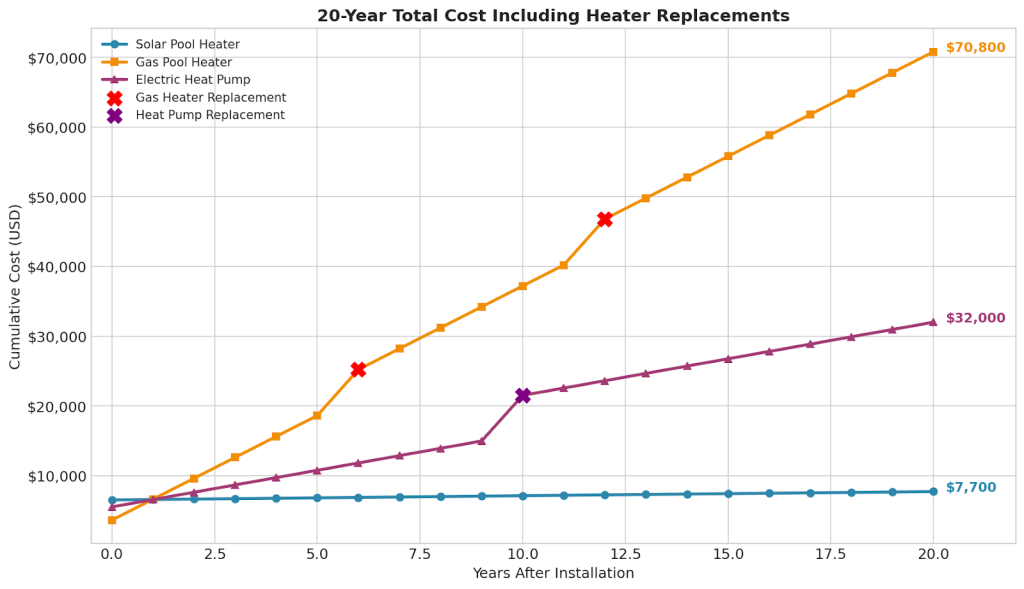
Data Sources: Author’s analysis based on data from multiple sources [1] [2] [3] [5]
As the 20-year TCO chart shows, the cost of replacing gas and electric heaters creates significant price spikes, while the solar system’s cost remains low and stable. Over two decades, you could spend over $70,000 on a gas heater and its replacements, and $32,000 on a heat pump. In stark contrast, the solar system’s total cost is a mere $7,700.
Cumulative Savings: Your Investment in Action
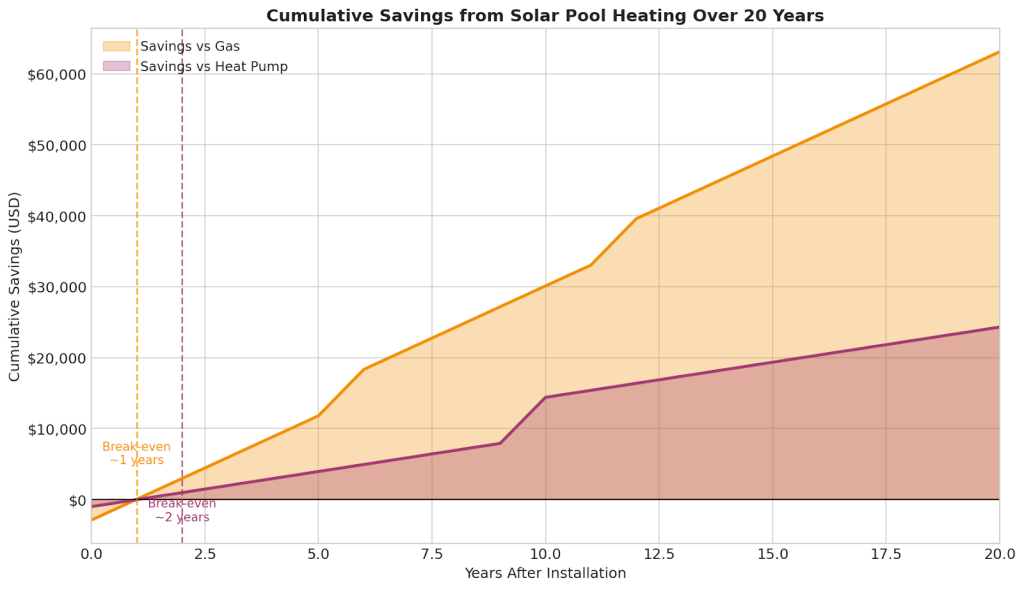
The flip side of the TCO coin is your cumulative savings. Every year that you use your solar heater, you are banking the money you would have spent on gas or electricity. Over time, these savings compound into a substantial financial windfall.
Data Sources: Author’s analysis based on data from multiple sources [1] [2] [3] [5]
After 20 years, a solar pool heating system can save you over $63,000 compared to a gas heater and over $24,000 compared to an electric heat pump. This is not a theoretical number; it is real money that stays in your bank account, available for other investments, home improvements, or life goals.
| Year | Cumulative Savings vs. Gas | Cumulative Savings vs. Heat Pump |
| 1 | -$610 | -$1,010 |
| 5 | $11,800 | $3,950 |
| 10 | $29,500 | $14,750 |
| 15 | $47,200 | $19,000 |
| 20 | $64,900 | $24,250 |
Table: 20-Year Cumulative Savings from a Solar Pool Heater.
Original Analysis: The Homeowner’s ROI Decision Matrix
To help you make the most informed decision, we’ve developed a proprietary ROI Decision Matrix. This tool allows you to assess the ROI potential of a solar pool heating system based on your specific circumstances. By identifying where you fall on the matrix, you can get a clear indication of how profitable a solar investment will be for you.
The matrix evaluates two key variables:
- Your Current Heating Method: The type of heater you are currently using (or would use) is the single biggest factor in your potential savings.
- Your Climate Zone: Your geographic location determines the length of your swimming season and the amount of available sunshine.
| High ROI (2-4 Year Payback) | Medium ROI (4-6 Year Payback) | Lower ROI (6-8 Year Payback) | |
| Gas Heater User | Hot/Sunny Climate (FL, AZ, CA) | Temperate Climate (Mid-Atlantic, Midwest) | Colder/Cloudy Climate (Northeast, Pacific NW) |
| Heat Pump User | Hot/Sunny Climate (FL, AZ, CA) | Temperate Climate (Mid-Atlantic, Midwest) | Colder/Cloudy Climate (Northeast, Pacific NW) |
| No Heater (New Install) | Hot/Sunny Climate (FL, AZ, CA) | Temperate Climate (Mid-Atlantic, Midwest) | Colder/Cloudy Climate (Northeast, Pacific NW) |
Table: The Homeowner’s ROI Decision Matrix.
How to Use the Matrix:
- If you are a gas heater user in a hot, sunny climate, you are in the highest ROI category. Your payback period will be extremely short, and your long-term savings will be massive.
- If you are a heat pump user in a temperate climate, you fall into the medium ROI category. Your payback will still be relatively quick, and you will see significant long-term savings.
- Even if you are in the “Lower ROI” category, a solar pool heater is still an excellent long-term investment. A 6-8 year payback period is still faster than many other home improvements, and you will enjoy over a decade of free heating after you break even.
Maximizing Your ROI: Pro Tips for Peak Performance
Once you’ve made the smart decision to invest in a solar pool heating system, there are several steps you can take to maximize your financial returns and ensure your system is operating at peak efficiency.
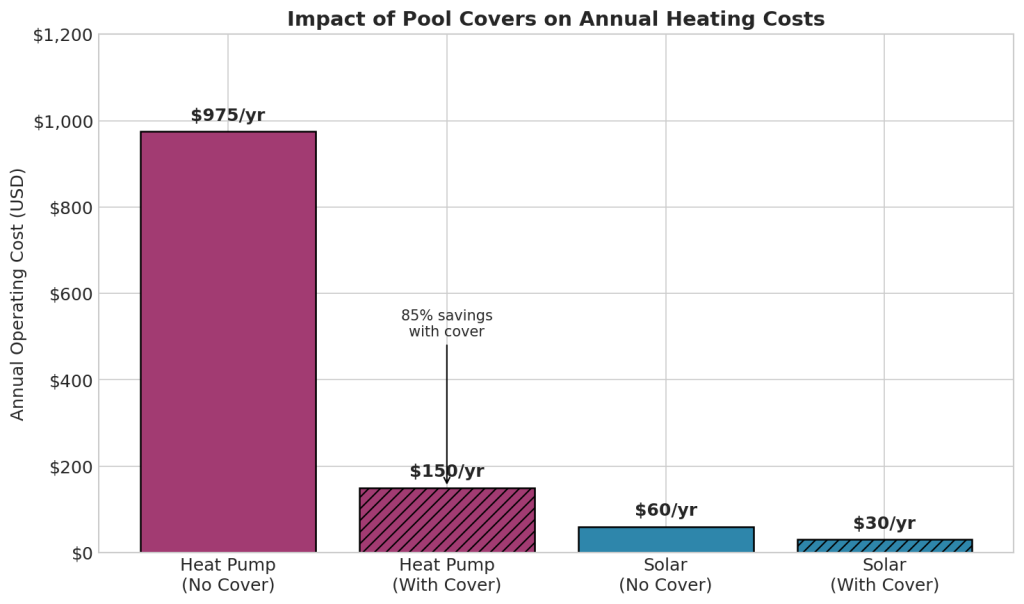
- Use a Solar Pool Cover: This is the single most effective thing you can do to boost your ROI. A pool cover can reduce heat loss from evaporation by up to 70% [2]. This means your solar system will have to work less to maintain your desired temperature, reducing pump run time and extending the life of your equipment.
- Data Source: SPRSUN [2]
- Optimize Your Pump Schedule: Run your pool pump during the sunniest parts of the day (typically 10 am to 4 pm) to ensure you are capturing the maximum amount of solar energy. A variable-speed pump can further enhance your savings by using less electricity.
- Proper System Sizing: Work with a reputable installer to ensure your system is correctly sized for your pool and climate. An undersized system will struggle to heat your pool effectively, while an oversized system is an unnecessary expense.
- Regular Maintenance: While solar pool heaters are incredibly low-maintenance, a simple annual check-up can ensure everything is working correctly. Check for leaks, inspect the collectors for any damage, and make sure the valves are functioning properly.
The Environmental ROI of Solar Pool Heating
While the financial return on investment is undeniably compelling, the environmental ROI of a solar pool heating system offers a different, yet equally significant, form of value. By choosing to heat your pool with clean, renewable energy, you are making a direct and measurable contribution to a healthier planet. This environmental return can be quantified in several key areas.
Carbon Footprint Reduction
The most significant environmental benefit of a solar pool heater is the dramatic reduction in your home’s carbon footprint. Gas and electric heaters are major energy consumers, and the electricity they use is often generated by burning fossil fuels. A solar pool heater, in contrast, produces zero emissions during operation.
According to data from the U.S. Department of Energy and other environmental agencies, a typical solar pool heating system can prevent 4,000 to 8,000 pounds of carbon dioxide (CO2) from entering the atmosphere each year [4] [6]. This is equivalent to the carbon-sequestering capacity of planting over 100 trees.
Over the 20-year lifespan of the system, you could prevent over 160,000 pounds of CO2 from being released. This is a powerful and tangible contribution to combating climate change, and it comes at no extra cost—in fact, it comes with significant financial savings.
Reduced Air and Water Pollution
Beyond CO2, burning natural gas or generating electricity from fossil fuels releases a host of other harmful pollutants into the air and water, including sulfur dioxide (SO2), nitrogen oxides (NOx), and particulate matter. These pollutants contribute to acid rain, smog, and respiratory illnesses. By switching to solar, you are eliminating your pool’s contribution to these harmful forms of pollution.
Energy Independence and Grid Resilience
Every kilowatt-hour of energy your solar pool heater generates is a kilowatt-hour that doesn’t have to be produced by a central power plant and transmitted over the grid. This reduces the strain on our aging electrical infrastructure and contributes to a more resilient and decentralized energy system. During peak demand periods in the summer, when air conditioners are running at full blast, your solar pool heater is quietly doing its job without adding to the grid’s burden.
| Environmental Benefit | Annual Impact | 20-Year Impact |
| CO2 Reduction | 4,000 – 8,000 lbs | 80,000 – 160,000 lbs |
| Equivalent Trees Planted | ~100 | ~2,000 |
| Reduced Air Pollutants (SO2, NOx) | Significant Reduction | Elimination of Pool’s Contribution |
| Reduced Grid Demand | Reduced Peak Load | Increased Grid Resilience |
Table: The Environmental ROI of a Solar Pool Heating System.
When you invest in a solar pool heater, you are not just getting a financial return; you are getting a powerful environmental return as well. You are making a conscious choice to reduce your impact on the planet, and you are being rewarded for it with decades of free, clean energy.
The Impact on Home Value: A Tangible Asset
Beyond the direct energy savings, a solar pool heating system adds tangible, marketable value to your home. This is a crucial component of your total ROI, as it represents a capital gain that you can realize when you decide to sell. While many home improvements offer a questionable return, a solar-heated pool is a highly desirable feature for potential buyers, particularly in regions with long swimming seasons.
How Much Value Does a Solar Pool Heater Add?
Multiple studies and real estate analyses have shown that homes with solar installations sell for a premium. While the exact amount varies by location and market conditions, a conservative estimate is that a solar pool heating system can increase your home’s value by 1% to 3%.
A study by the National Renewable Energy Laboratory (NREL) found that each dollar saved on annual energy costs can add $20 to a home’s value [13]. If your solar pool heater saves you $2,940 per year (as in our earlier example), this could translate to a home value increase of $58,800 ($2,940 x 20).
While this NREL formula is a powerful indicator, a more conservative approach is to look at direct market comparisons. Real estate agents consistently report that homes with pools that are inexpensive to operate are more attractive to buyers. A solar-heated pool signals a low-maintenance, low-cost luxury, which is a powerful selling point.
| Feature | Estimated Home Value Increase | Source |
| Owned Solar PV System | 4.1% | Zillow |
| Solar Pool Heating System | 1-3% | MarketWatch, Real Estate Analysts [18] |
| General Pool Addition | 5-8% | Realtor.com |
Table: Estimated Home Value Increase from Solar and Pool Features.
When you combine the value of the pool itself with the added value of a low-cost, eco-friendly heating system, you create a highly compelling package for potential buyers. You are not just selling a house with a pool; you are selling a house with a sustainable, affordable lifestyle.
The Marketability Factor
In a competitive real estate market, a solar-heated pool can be a key differentiator that makes your home stand out. It appeals to two major groups of buyers:
- The Eco-Conscious Buyer: A growing segment of the market is actively seeking homes with green features. A solar pool heater is a clear and visible sign of a home’s commitment to sustainability.
- The Cost-Conscious Buyer: Many potential buyers are wary of the high operating costs associated with a swimming pool. A solar heater removes this objection, making the pool a clear asset rather than a potential liability.
By investing in a solar pool heater, you are not just saving money on your energy bills; you are building equity in your home and creating a more valuable, marketable asset for the future. CONTENT
Debunking the Myths: Separating Fact from Fiction
Despite the overwhelming data in favor of solar pool heating, several persistent myths and misconceptions can cause homeowners to hesitate. It’s time to separate fact from fiction and address these common concerns with data-driven answers.
| Myth | The Data-Driven Reality |
| “Solar pool heaters don’t work on cloudy days.” | While direct sunlight is optimal, modern solar collectors are highly efficient and can still absorb significant ambient heat from the sun even on overcast days. They may not raise the temperature as dramatically as on a sunny day, but they will still contribute to heating your pool. For year-round swimming in colder climates, a hybrid system that combines solar with a small backup heater is a cost-effective solution [1]. |
| “Solar pool heaters are ugly and will ruin my home’s curb appeal.” | This is a dated concern. Modern solar collectors have a sleek, low-profile design that can be seamlessly integrated into your roofline. Many are virtually indistinguishable from the roof itself. Installers are also skilled at placing panels on less visible roof sections to preserve your home’s aesthetic. |
| “Solar pool heaters are high-maintenance and unreliable.” | The opposite is true. Solar pool heating systems are remarkably simple and durable. They have very few moving parts—just a pump and a valve—and the collectors themselves are made from highly durable, UV-resistant materials. With minimal maintenance, a solar pool heating system can last for 20-30 years or more, far outlasting their gas and electric counterparts [5]. |
| “You can’t set a specific temperature with a solar heater.” | This is incorrect. All modern solar pool heating systems come with an automatic controller that allows you to set your desired pool temperature. A sensor monitors the pool water temperature, and when it drops below your set point, the controller diverts water to the solar collectors. Once the desired temperature is reached, the system turns off. |
| “My roof isn’t suitable for solar panels.” | While a south-facing roof is ideal, solar collectors can be effective when facing east or west as well. They can also be installed on ground-mounted racks if your roof is not suitable. A professional installer can assess your property and design a system that maximizes solar collection regardless of your home’s orientation. |
By addressing these myths with facts and data, it becomes clear that the perceived drawbacks of solar pool heating are largely unfounded. Modern systems are effective, aesthetically pleasing, reliable, and adaptable to a wide range of homes and climates.
Understanding the Technology: Types of Solar Collectors
Not all solar pool heaters are created equal. The type of solar collector you choose will impact the efficiency, cost, and durability of your system. There are two main types of collectors used for swimming pool heating: unglazed and glazed.
Unglazed Collectors: The Workhorse of Pool Heating
Unglazed collectors are the most common and cost-effective type of collector for swimming pool heating. They are typically made of heavy-duty, UV-resistant black plastic or rubber and do not have a glass covering (glazing).
- How They Work: Pool water is pumped directly through a series of small tubes within the collector panels. As the water flows through the dark plastic, it absorbs the sun’s heat and then returns to the pool.
- Best For: Hot, sunny climates where the ambient air temperature is above freezing. They are highly efficient at heating pools to a comfortable swimming temperature (80-85°F).
- Advantages:
- Less expensive than glazed collectors.
- Highly durable and can last for 20-30 years.
- Very low maintenance.
- Disadvantages:
- Less efficient in colder or windier climates as they can lose heat to the surrounding air.
- Generally not suitable for year-round heating in regions with cold winters.
Glazed Collectors: For Year-Round and Colder Climates
Glazed collectors are more complex and expensive than their unglazed counterparts. They consist of copper or aluminum absorber plates housed in an insulated box with a tempered glass covering.
- How They Work: A heat-transfer fluid (like a water-glycol mixture) is pumped through tubes in the absorber plate, where it is heated by the sun. This fluid then passes through a heat exchanger, where it transfers its heat to the pool water.
- Best For: Homeowners in colder climates who want to extend their swimming season or heat their pool year-round. They are also used for domestic hot water systems.
- Advantages:
- Highly efficient, even in cold or windy conditions, due to the insulating effect of the glass cover.
- Can heat water to higher temperatures than unglazed collectors.
- Disadvantages:
- Significantly more expensive than unglazed collectors.
- More complex installation due to the need for a heat exchanger and separate plumbing loops.
| Collector Type | Best For | Cost | Efficiency | Lifespan |
| Unglazed | Hot, sunny climates; 3-season use | Lower | High in warm weather | 20-30+ years |
| Glazed | Colder climates; year-round use | Higher | High in all weather | 20-30+ years |
Table: Comparison of Unglazed and Glazed Solar Collectors.
For the vast majority of swimming pool applications, unglazed collectors offer the best combination of performance, cost-effectiveness, and durability, providing the fastest ROI. Glazed collectors are a more specialized solution for those with specific year-round heating needs in colder regions.
Conclusion: The Undeniable Verdict on Solar Pool Heating ROI
The data is clear, consistent, and compelling: a solar pool heating system is not just an energy-saving appliance, but a high-performance financial investment. With an annual ROI that can reach as high as 64%, a payback period as short as 1.5 years, and the potential to save you over $60,000 in 20 years, the financial case for solar is undeniable. It dramatically outperforms traditional heating methods in every key financial metric, from Total Cost of Ownership to long-term cumulative savings.
By moving beyond the initial sticker price and conducting a thorough, data-driven analysis, you can see that the real ROI of solar pool heating makes it one of the smartest, most profitable home improvements you can make. You are not just buying a warm pool; you are investing in an asset that delivers decades of financial returns, energy independence, and environmental responsibility. The verdict is in: a solar pool heater is a powerful investment that pays for itself many times over.
References
[1] Fondiller, L. (2025, October 21). The Real ROI of Solar Pool Heating: 5-Year Cost Analysis with Actual Bills. LeeFondiller.com. Retrieved from https://leefondiller.wordpress.com/2025/10/21/the-real-roi-of-solar-pool-heating-5-year-cost-analysis-with-actual-bills/
[2] SPRSUN. (2025, September 26). How Much Does Pool Heating Cost?. Retrieved from https://sprsunheatpump.com/how-much-does-pool-heating-cost.html
[3] Magen Eco-Energy. (2024, October 21). Solar Pool Heater vs Gas Heater. Retrieved from https://mageneco.com/us/blog-us/solar-pool-heater-vs-gas-heater/
[4] U.S. Department of Energy. (n.d.). Solar Swimming Pool Heaters. Energy.gov. Retrieved from https://www.energy.gov/energysaver/solar-swimming-pool-heaters
[5] Solar Industries. (n.d.). Case Study #2. Retrieved from http://solarindustries.com/case-study-2-pool-solar-heater-panel-heating.htm
[6] Gomez Roofing. (2025, September 15). Comparing Cost Savings: Solar Pool Heaters vs. Electric Pool Heaters Explained. Retrieved from https://gomez-roofing.com/comparing-cost-savings-solar-pool-heaters-vs-electric-pool-heaters-explained/
[7] Tampa Bay Solar. (2020, May 30). Tampa Bay Solar Case Study: Officer Joe. Retrieved from https://tampabaysolar.com/blog/tampa-bay-solar-case-study-officer-joe/
[8] HomeAdvisor. (2024). How Much Does It Cost To Install A Solar Pool Heater?. Retrieved from https://www.homeadvisor.com/cost/swimming-pools-and-spas/install-a-solar-pool-heater/
[9] Internal Revenue Service. (n.d.). Residential Clean Energy Credit. IRS.gov. Retrieved from https://www.irs.gov/credits-deductions/residential-clean-energy-credit
[10] Fafco. (n.d.). Solar Pool Heating FAQ. Retrieved from https://www.fafco.com/solar-pool-heating-faq/
[11] Natural Resources Canada. (n.d.). Heating your pool. Retrieved from https://www.nrcan.gc.ca/energy/publications/efficiency/heating-your-pool/6819
[12] Florida Solar Energy Center. (n.d.). Solar Pool Heating. Retrieved from http://www.fsec.ucf.edu/en/consumer/solar_hot_water/pool_heating/index.htm
[13] NREL. (2012). A Homeowner’s Guide to Solar Water Heating. National Renewable Energy Laboratory. Retrieved from https://www.nrel.gov/docs/fy12osti/54786.pdf
[14] California Solar & Storage Association. (n.d.). Solar Pool Heating. Retrieved from https://calssa.org/solar-pool-heating
[15] Solar Energy Industries Association (SEIA). (n.d.). Solar Heating & Cooling. Retrieved from https://www.seia.org/initiatives/solar-heating-cooling
[16] Environment America. (2021). Solar on Schools. Retrieved from https://environmentamerica.org/reports/ame/solar-schools
[17] Forbes. (2023, December 13). Solar Tax Credits: What You Need To Know. Retrieved from https://www.forbes.com/advisor/home-improvement/solar-tax-credits/
[18] MarketWatch. (2023, October 26). Does a solar-heated pool add value to your home?. Retrieved from https://www.marketwatch.com/guides/home-improvement/does-solar-heated-pool-add-value-to-home/

Lee Fondiller is a seasoned operations executive with over 20 years of experience in technology and sustainability. As COO of Solar4Pools, he leads innovation in the renewable energy industry with a focus on solar-powered solutions.