
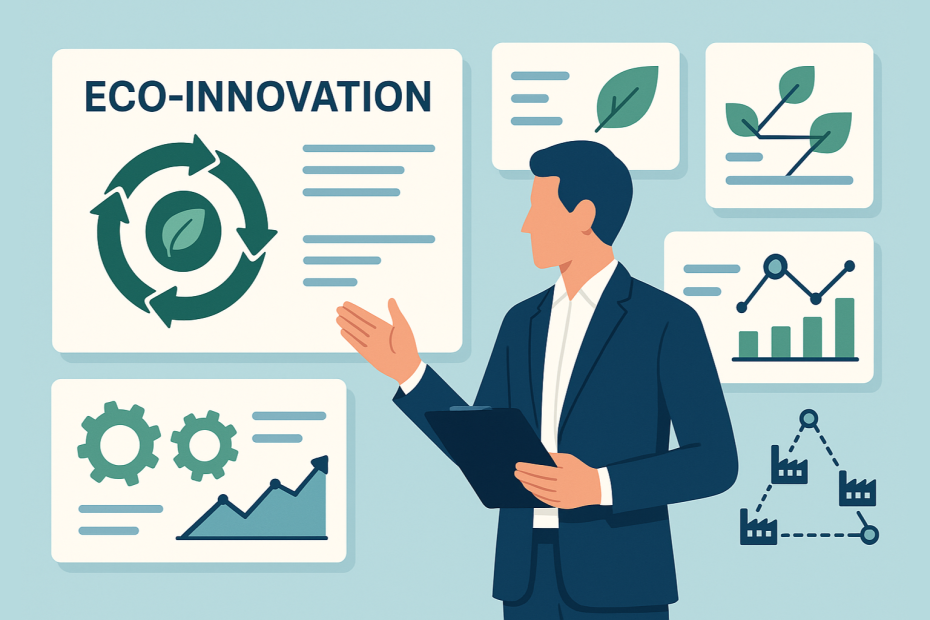
Eco-innovation is disrupting industries by introducing sustainable business models, nature-inspired design, digital automation, industrial collaboration, and resilient startups that create both economic and environmental value.
This article examines how eco-innovation shapes the future of green entrepreneurship. You’ll explore the rise of circular business models, biomimicry-driven design, automation for sustainability, industrial resource sharing, and the resilience of green startups—giving you a practical roadmap to compete in industries being reshaped by environmental imperatives.
What green business models are reshaping traditional industries?
Circular economy models are replacing linear “take, make, waste” systems. Businesses design products for reuse, repair, and remanufacturing, ensuring resources remain in circulation.
The Ellen MacArthur Foundation projects that circular economy adoption in Europe could generate $700 billion in annual savings by 2030. In the furniture industry alone, refurbishing and resale initiatives are creating jobs while cutting resource consumption.
For your business, circularity can manifest as subscription services, take-back schemes, or product-as-a-service models. Each approach extends customer relationships while turning sustainability into profit.
How is biomimicry driving eco-innovation across sectors?
Biomimicry leverages nature’s proven strategies to solve industrial challenges. From gecko-inspired adhesives to beetle-inspired moisture-harvesting surfaces, it delivers performance with minimal environmental cost.
The Shinkansen bullet train redesign, modeled on a kingfisher’s beak, reduced noise pollution and energy consumption. Companies like Interface, a global carpet manufacturer, use biomimicry to design modular flooring systems that mimic natural ecosystems, cutting waste significantly.
As a green entrepreneur, adopting biomimicry positions your products as both innovative and sustainable, giving you competitive differentiation in resource-intensive markets.
What role does automation play in scaling green innovation?
Automation and digitalization accelerate sustainability adoption. Robotic Process Automation (RPA), IoT, and AI help businesses reduce inefficiencies, track energy consumption, and embed ESG compliance seamlessly into daily operations.
A recent study found that firms leveraging automation reported significantly higher ESG ratings, linking operational efficiency directly with environmental performance. Smart meters, predictive analytics, and automated auditing systems ensure sustainability is measurable and scalable.
By embedding automation into your processes, you cut energy waste, reduce reporting costs, and generate real-time insights that improve both profitability and impact.
How are eco-innovative startups gaining competitive advantage?
Startups adopting eco-innovation gain resilience and investor attention. Research from Italy showed that green startups were twice as likely to survive beyond the five-year mark compared to conventional peers.
Investors and consumers alike are prioritizing businesses with transparent sustainability strategies. This makes eco-innovation more than a differentiator—it is a survival mechanism.
For you, integrating sustainability from day one lowers regulatory risk, strengthens market appeal, and increases operational efficiency, ensuring long-term competitiveness in industries undergoing disruption.
How does industrial symbiosis create large-scale sustainability benefits?
Industrial symbiosis is a resource-sharing model where one company’s by-products fuel another’s processes. Kalundborg, Denmark, is a flagship example: waste heat from a power plant warms nearby homes, while gypsum by-products become raw materials for construction.
This creates a win-win for businesses—lower input costs and reduced waste disposal liabilities—while strengthening community and ecosystem health.
You can apply this by identifying local partners for resource exchanges, joining eco-industrial parks, or investing in shared logistics systems that cut costs while boosting sustainability.
Why are governments and investors betting big on eco-innovation?
Policy frameworks and financial institutions are fueling eco-innovation. The European Green Deal alone aims to mobilize €1 trillion in sustainable investments over the next decade.
The World Economic Forum emphasizes that sustainability is now linked with competitiveness, not just compliance. Companies aligned with climate targets are attracting premium valuations and securing easier access to capital.
For your business, this means that eco-innovation not only builds resilience but also positions you to benefit from favorable regulations, subsidies, and investor interest.
What strategic actions should green entrepreneurs prioritize today?
To maximize your competitive edge, you should:
- Design products for circularity and reuse.
- Adopt biomimicry to inspire new efficiencies.
- Implement automation to measure and improve ESG performance.
- Build resilience with eco-driven business models.
- Seek industrial partnerships for resource exchanges.
- Leverage policy and investor incentives for scaling growth.
These actions create a foundation for long-term advantage in industries being disrupted by eco-innovation.
What are the biggest industry shifts driven by eco-innovation?
Several industries are already undergoing structural change:
- Energy: Renewables and distributed grids disrupt fossil fuel markets.
- Transportation: EVs, shared mobility, and biomimetic design reshape automotive.
- Construction: Modular, recyclable materials lower carbon intensity.
- Food and Agriculture: Vertical farming, regenerative practices, and biotech alternatives transform supply chains.
- Fashion: Circular textiles and biodegradable fibers disrupt fast fashion.
Each of these sectors shows how eco-innovation is not optional but integral to survival in the decade ahead.
How is eco-innovation disrupting industries?
- Circular business models reduce waste.
- Biomimicry inspires efficient design.
- Automation drives measurable ESG gains.
- Green startups show higher survival.
- Industrial symbiosis reduces costs.
In Conclusion
You can lead the future of green entrepreneurship by embracing eco-innovation across your strategy. Circularity, biomimicry, automation, resilient startups, and industrial symbiosis are no longer optional—they are the levers disrupting industries worldwide. By adopting them, you secure competitive relevance, attract investment, and deliver measurable environmental and business value.

Lee Fondiller is a seasoned operations executive with over 20 years of experience in technology and sustainability. As COO of Solar4Pools, he leads innovation in the renewable energy industry with a focus on solar-powered solutions.