
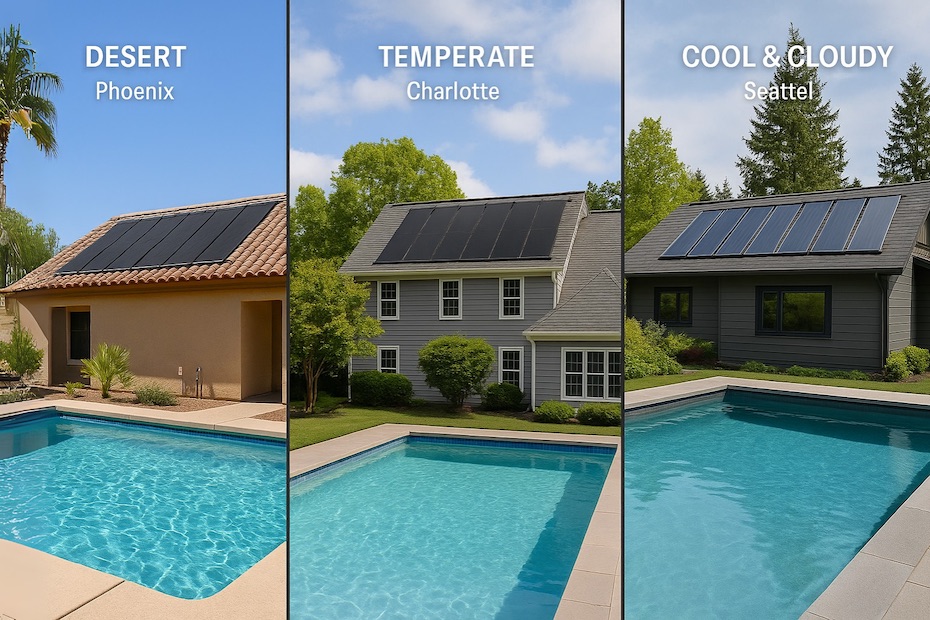
Yes, solar pool heating is effective in a wide range of climates, not just sunny regions; the key is to properly size the system and select the right type of collectors for your specific location. This guide will show you how to achieve optimal performance whether you live in a hot, temperate, or even a cold and cloudy climate.
As a pool heating professional, one of the most common questions I hear is, “Will solar work for me?” Many homeowners assume that solar pool heating is only for places like Florida or Arizona. This article will debunk that myth by providing a detailed, data-driven look at how to successfully install and operate a solar pool heating system in three distinct climate zones: a hot, sunny climate (Phoenix, AZ), a temperate, four-season climate (Charlotte, NC), and a cold, cloudy climate (Seattle, WA). You will get real-world examples, sizing guidelines, and performance expectations for each.
How Does Climate Impact Solar Pool Heating Performance?
Climate is the single most important factor in determining the performance and sizing of a solar pool heating system. The amount of available solar energy, the ambient air temperature, and the length of your desired swimming season all play a critical role. A system that works perfectly in Phoenix would be undersized in Seattle, and a system designed for Seattle would be oversized and unnecessarily expensive in Phoenix.
The primary metric used to measure solar energy is solar insolation, which is the amount of solar radiation that reaches a given surface area. This varies significantly by location and time of year. For example, Phoenix receives an average of over 6 kWh/m²/day of solar insolation, while Seattle receives just over 3 kWh/m²/day. This means that a solar collector in Phoenix will generate nearly twice as much heat as the same collector in Seattle.
Ambient air temperature also plays a significant role. The colder the air, the more heat the pool will lose to the environment, and the harder the solar system will have to work to maintain a comfortable temperature. Wind is another major factor; a windy location will experience significantly more evaporative heat loss, which can dramatically increase the heating load. Understanding these climate-specific factors is the first step in designing an effective solar pool heating system.
Case Study 1: Hot, Sunny Climate (Phoenix, AZ)
In a hot, sunny climate like Phoenix, solar pool heating is an incredibly effective and popular choice. The abundance of year-round sunshine means that a properly sized system can provide a 10-12 month swimming season with minimal operational cost. The primary challenge in this climate is not heating the pool, but rather controlling the heat during the scorching summer months.
A typical solar pool heating system in Phoenix is sized to be 80-100% of the pool’s surface area. For a 20,000-gallon pool with a surface area of 600 square feet, this would mean a collector array of 480-600 square feet. This size is sufficient to raise the pool temperature by 10-15°F, easily extending the swimming season into the cooler spring and fall months. In the summer, the system is so effective that it can overheat the pool, with temperatures climbing into the high 90s. To combat this, many homeowners in hot climates use their solar system for “nocturnal cooling” by running it at night to radiate heat out of the pool and into the cooler night sky.
The economics of solar in a hot climate are compelling. A typical system costs between $4,000 and $6,000 to install. With the high cost of running a gas heater or heat pump to extend the season, the payback period for a solar system in Phoenix is often just 1-2 years. The long-term savings are substantial, and the environmental benefits are a significant bonus.
| Climate Factor | Phoenix, AZ |
|---|---|
| Climate Zone | Hot, Sunny (Köppen BWh) |
| Average Solar Insolation | 6.5 kWh/m²/day |
| Recommended Collector Sizing | 80-100% of pool surface area |
| Expected Swimming Season | 10-12 months |
| Key Consideration | Nocturnal cooling to prevent overheating in summer |
Case Study 2: Temperate, Four-Season Climate (Charlotte, NC)
In a temperate, four-season climate like Charlotte, solar pool heating is an excellent way to extend the swimming season and significantly reduce your heating costs. While you will not get a year-round swimming season like you would in Phoenix, you can realistically expect to add 2-3 months of comfortable swimming to your season, typically from April through October.
The key to success in a temperate climate is proper sizing and the use of a pool cover. A system in Charlotte should be sized to be 100-120% of the pool’s surface area. For our 600-square-foot pool, this would mean a collector array of 600-720 square feet. This larger size is necessary to compensate for the lower solar insolation and cooler ambient temperatures compared to a hot climate. A pool cover is also essential in a temperate climate, as it dramatically reduces heat loss overnight, allowing the solar system to be much more effective.
With a properly sized system and a pool cover, you can expect your pool to be in the comfortable 80-85°F range for an extended 6-7 month season. The payback period for a solar system in a temperate climate is typically 3-5 years, which is still an excellent return on investment. The system will pay for itself many times over during its 15-20 year lifespan.
| Climate Factor | Charlotte, NC |
|---|---|
| Climate Zone | Temperate, Four-Season (Köppen Cfa) |
| Average Solar Insolation | 4.5 kWh/m²/day |
| Recommended Collector Sizing | 100-120% of pool surface area |
| Expected Swimming Season | 6-7 months (April-October) |
| Key Consideration | A pool cover is essential for heat retention |
Case Study 3: Cold, Cloudy Climate (Seattle, WA)
This is where the myth of solar pool heating being ineffective is most prevalent, but with the right system design, it is absolutely possible to get great results in a cold, cloudy climate like Seattle. You will not be swimming in December, but you can realistically extend your season by 2-3 months and enjoy a warm pool during the summer without a massive heating bill. The key is to maximize your collector size and to use glazed, high-performance collectors.
In a climate like Seattle, you need to oversize your collector array to compensate for the lower solar insolation. A sizing of 120-150% of the pool’s surface area is recommended. For our 600-square-foot pool, this would mean a collector array of 720-900 square feet. It is also highly recommended to use glazed solar collectors in a cold climate. These collectors have a glass cover over the absorber plate, which traps heat and makes them much more efficient in cooler, windier conditions. While more expensive, they are essential for getting good performance in a challenging climate.
With a large, glazed collector array and a pool cover, you can expect to have a comfortable swimming season from June through September in Seattle. The system will provide the majority of your heating needs during this period, and you may only need to supplement with a gas heater or heat pump on the coldest days. The payback period for a solar system in a cold climate is longer, typically 5-7 years, but the long-term savings are still substantial, and the environmental benefits are significant.
| Climate Factor | Seattle, WA |
|---|---|
| Climate Zone | Cold, Cloudy (Köppen Csb) |
| Average Solar Insolation | 3.2 kWh/m²/day |
| Recommended Collector Sizing | 120-150% of pool surface area |
| Collector Type | Glazed collectors are highly recommended |
| Expected Swimming Season | 4-5 months (June-September) |
| Key Consideration | Maximize collector size and use a pool cover |
What Are the Different Types of Solar Collectors?
There are two main types of solar collectors used for pool heating: unglazed collectors and glazed collectors. The choice between them depends primarily on your climate and your budget. Unglazed collectors are the most common type for pool heating, while glazed collectors are a more premium option for colder climates.
Unglazed collectors are simple, durable panels made of black plastic or rubber. They are very effective at absorbing solar energy and transferring it to the pool water. They are also relatively inexpensive and have a very long lifespan. However, they are not insulated, so they can lose a significant amount of heat to the environment in cold or windy conditions. This makes them best suited for hot and temperate climates.
Glazed collectors, on the other hand, have a glass cover over the absorber plate and are insulated on the back and sides. This design traps heat much more effectively, making them the ideal choice for cold, cloudy, and windy climates. They can operate efficiently even on cool, overcast days. The trade-off is that they are more expensive than unglazed collectors, but the improved performance in a challenging climate often justifies the additional cost.
The Critical Role of a Pool Cover
A pool cover is the single most important accessory for any heated pool, but it is absolutely essential for a solar-heated pool, especially in temperate and cold climates. A pool cover can reduce heat loss by up to 70%, which has a dramatic impact on the performance and efficiency of your solar system. Without a cover, much of the heat your solar system generates during the day will be lost to the atmosphere overnight.
There are several types of pool covers, but the most common for solar-heated pools is a “solar blanket,” which is a large sheet of plastic with air bubbles that floats on the surface of the water. These covers are relatively inexpensive and are very effective at reducing evaporation, which is the primary cause of heat loss in a swimming pool. They also help to absorb some solar energy themselves, further contributing to the heating of the pool.
Using a pool cover can make the difference between a lukewarm pool and a comfortably warm pool in a temperate or cold climate. It allows your solar system to work much more efficiently, as it does not have to constantly fight against heat loss. While it can be a bit of a chore to put on and take off, the benefits of using a pool cover far outweigh the inconvenience.
A Deeper Look at the Economics
The financial case for solar pool heating is strong in all three climates, but the specifics of the payback period and the long-term return on investment vary. In all cases, the upfront cost of a solar system is offset by the elimination of monthly heating bills, leading to significant savings over the life of the system.
In Phoenix, the payback period is incredibly short, often just 1-2 years. This is because the long swimming season and high solar insolation mean that homeowners are replacing a very high gas or electric heating bill with free solar energy for most of the year. The return on investment is massive, with the system paying for itself many times over.
In Charlotte, the payback period is a bit longer, typically 3-5 years. The savings are still substantial, but the shorter swimming season means it takes a bit longer to recoup the initial investment. However, with a 15-20 year lifespan, the system will still provide over a decade of free heating after it has paid for itself. In Seattle, the payback period is the longest, typically 5-7 years. The higher cost of the glazed collectors and the larger system size contribute to this. However, the savings are still significant, especially when compared to the high cost of heating a pool with gas or electricity in a cold climate. The long-term return on investment is still very attractive, and the environmental benefits are a major bonus.
Installation Considerations in Different Climates
The installation process for a solar pool heating system is similar in all climates, but there are some key differences to be aware of. In hot climates like Phoenix, the plumbing must be able to withstand very high temperatures, as the water coming from the collectors can be extremely hot. It is also important to have a properly installed and automated drain-down system to protect the collectors from freezing on the rare occasions when temperatures drop below freezing.
In temperate climates like Charlotte, freeze protection is a more significant concern. The system must be designed to drain completely when not in use to prevent damage from freezing pipes. This is typically accomplished with an automatic drain-down valve that is controlled by the solar controller. It is also important to ensure that all plumbing is properly insulated to minimize heat loss.
In cold climates like Seattle, freeze protection is absolutely critical. The system must be designed to drain back to the pool whenever the pump is not running. This is the most reliable method of freeze protection, and it is essential for ensuring the long-term reliability of the system. It is also important to use high-quality, freeze-tolerant materials for all plumbing and components.
How Pool Usage Patterns Affect System Design
Your family’s pool usage patterns can also have a significant impact on the design of your solar pool heating system. If you are a family that primarily uses the pool on weekends, you may be able to get by with a slightly smaller system, as you will have all week to heat the pool. However, if you are a family that uses the pool every day, you will need a larger system to keep up with the daily heat loss.
If you have a spa that you like to keep at a very high temperature, you will need to factor this into your system design. A solar system can be used to pre-heat the spa, which can significantly reduce the amount of time it takes to heat with a gas heater or heat pump. However, a solar system alone is typically not sufficient to heat a spa to a high temperature on its own, especially in a temperate or cold climate.
It is important to have a conversation with your solar installer about your family’s specific pool usage patterns. This will help them to design a system that is tailored to your needs and that will provide you with the best possible performance and return on investment.
Climate Comparison Summary
| Feature | Phoenix, AZ (Hot/Sunny) | Charlotte, NC (Temperate) | Seattle, WA (Cold/Cloudy) |
|---|---|---|---|
| Sizing | 80-100% | 100-120% | 120-150% |
| Collector Type | Unglazed | Unglazed | Glazed |
| Pool Cover | Optional | Essential | Essential |
| Season | 10-12 months | 6-7 months | 4-5 months |
| Payback | 1-2 years | 3-5 years | 5-7 years |
The Importance of Roof Orientation and Tilt
The orientation and tilt of your roof are critical factors that can significantly impact the performance of your solar pool heating system. While a south-facing roof is ideal in the Northern Hemisphere, it is not always a requirement. Understanding how to work with different roof orientations is key to maximizing your solar investment.
A south-facing roof provides the most direct sun exposure throughout the day, making it the optimal location for solar collectors. However, east- and west-facing roofs can also be effective, especially if you oversize the system slightly to compensate for the less-than-ideal orientation. An east-facing roof will get more sun in the morning, while a west-facing roof will get more sun in the afternoon. In many cases, a split system with collectors on both east and west-facing roofs can provide excellent performance throughout the day.
The tilt of your roof also plays a role. The ideal tilt for a solar collector is equal to your latitude. This maximizes the amount of direct sunlight the collectors receive over the course of the year. However, most residential roofs have a fixed tilt, and it is generally not cost-effective to build a custom racking system to achieve the ideal tilt. Fortunately, solar pool heating systems are relatively forgiving when it comes to tilt, and they can perform well on a wide range of roof pitches.
The Role of Automation and Smart Controls
Modern solar pool heating systems are fully automated, thanks to sophisticated but easy-to-use smart controllers. These devices are the brains of the operation, and they play a critical role in maximizing the performance and efficiency of your system. Understanding how these controllers work will help you to get the most out of your solar investment.
A typical solar controller has two sensors: one that measures the temperature of the solar collectors, and one that measures the temperature of the pool water. The controller constantly compares these two temperatures. When the collectors are a few degrees warmer than the pool, the controller activates a diverter valve that sends water to the collectors to be heated. When the collectors are not warm enough to provide heat, the controller bypasses the collectors and sends the water directly back to the pool.
This simple but effective logic ensures that your system is only running when it can provide heat, maximizing its efficiency. Many modern controllers also have additional features, such as a “spa priority” mode that will heat your spa first, and a “nocturnal cooling” mode that will run the system at night to cool the pool in hot climates. These smart controls make the system completely hands-off, allowing you to enjoy a warm pool without having to constantly monitor and adjust the system.
Your Quick-Start Guide to Climate-Optimized Solar
To successfully heat your pool with solar, you must tailor your system to your climate. Hot climates need 80-100% collector coverage, temperate climates need 100-120% plus a cover, and cold climates need 120-150% coverage with high-performance glazed collectors.
Solar Is a Smart Choice in Any Climate
The evidence is clear: solar pool heating is a viable and intelligent investment in a wide range of climates. By understanding the specific challenges and opportunities of your location and by sizing your system accordingly, you can unlock significant savings and a longer, more enjoyable swimming season. Whether you are in the sun-drenched Southwest, the four-season Southeast, or the cool and cloudy Pacific Northwest, there is a solar solution that can work for you. The key is to work with a knowledgeable professional who can help you design a system that is optimized for your climate, your pool, and your goals.

Lee Fondiller is a seasoned operations executive with over 20 years of experience in technology and sustainability. As COO of Solar4Pools, he leads innovation in the renewable energy industry with a focus on solar-powered solutions.