
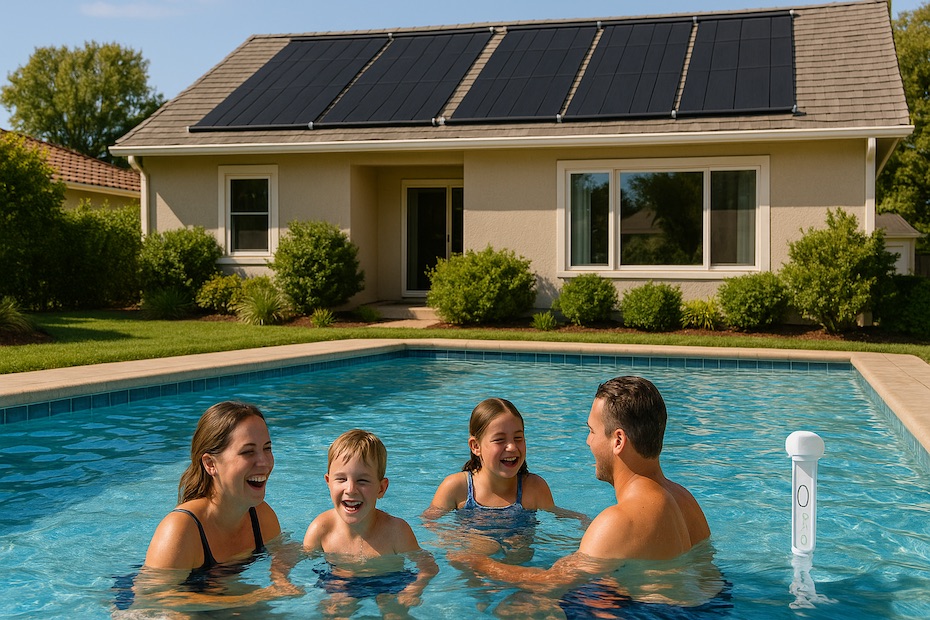
Yes, you can completely eliminate your pool heating bill by switching to a solar pool heating system. A properly sized solar system can provide 100% of your pool heating needs, allowing you to enjoy a warm pool with zero heating costs.
The dream of a warm, comfortable pool without the constant expense is not just a fantasy; it is a reality for thousands of solar pool owners. This article will provide a data-driven guide to how you can slash your pool heating bill to zero with solar, with real-world examples and a clear path to achieving your own energy independence.
How Much Can You Really Save?
The savings from a solar pool heating system are substantial and immediate. For most homeowners, a solar system will pay for itself in just 2-4 years, and after that, you will be enjoying over a decade of free heating for your pool. Let’s look at a real-world example.
A typical homeowner in a moderate climate with a 20,000-gallon pool can expect to spend $300-$500 per month on gas heating, or $100-$200 per month on a heat pump. That adds up to over $2,000 per season for gas, and up to $1,000 for a heat pump. With a solar system, your only ongoing cost is the small amount of electricity needed to run your pump, which is typically less than $40 per month.
When you do the math, the savings are clear. A solar system can save you over $1,500 per year compared to a gas heater, and over $600 per year compared to a heat pump. With a lifespan of 15-20 years, that adds up to over $20,000 in savings over the life of the system. It is an investment that not only pays for itself, but that also provides a significant return.
How to Calculate Your Current Costs
Before you can fully appreciate the savings from a solar system, you need to have a clear understanding of what you are currently spending to heat your pool. Many homeowners are surprised to learn just how much they are paying for a warm pool. Let’s break down how to calculate your current costs.
If you have a gas heater, the calculation is relatively simple. Look at your gas bills from the swimming season and identify the months when you were heating your pool. Subtract your average winter gas bill from your summer gas bill to isolate the cost of heating your pool. Be sure to account for any other gas appliances you may have, such as a water heater or a barbecue.
If you have a heat pump, the calculation is a bit more complex. You will need to look at your electric bills from the swimming season and identify the months when you were heating your pool. Subtract your average winter electric bill from your summer electric bill to isolate the cost of heating your pool. You will also need to account for the increased use of your air conditioner during the summer months. A good way to do this is to look at your electric bill from a shoulder month like May or September, when you are not using your air conditioner as much.
How to Size Your Solar System for 100% Offset
To completely eliminate your pool heating bill, you need to size your solar system to provide 100% of your heating needs. This is known as a 100% solar fraction, and it is achievable in most climates with a properly designed system. The key is to have enough collector area to generate sufficient heat, even on partly cloudy days.
The general rule of thumb is to size your solar system to be 50-100% of your pool’s surface area. However, to achieve a 100% solar fraction, you will need to be on the higher end of that range. For most climates, a system that is 80-100% of the pool’s surface area will be sufficient. In cooler, cloudier climates, you may need to go as high as 120%.
It is always better to oversize your system slightly than to undersize it. The additional cost of a larger system is relatively small, but the performance benefits are significant. A larger system will heat your pool faster, maintain a more consistent temperature, and give you a longer swimming season. It is a worthwhile investment that will ensure that you can truly slash your pool heating bill to zero.
What Is the Real Payback Period?
The payback period for a solar pool heating system is the amount of time it takes for the savings from the system to equal the upfront cost. For most homeowners, the payback period is between 2 and 4 years. This is an excellent return on investment, especially when you consider that the system has a lifespan of 15-20 years.
To calculate your payback period, you will need to know the upfront cost of your system and your annual savings. The upfront cost of a solar pool heating system is typically between $4,000 and $8,000 for a professional installation. Your annual savings will be the amount you were previously spending on gas or electric heating.
Let’s look at an example. If your system costs $6,000 to install and you are saving $1,500 per year on gas heating, your payback period would be 4 years ($6,000 / $1,500 = 4). After 4 years, you will have recouped your initial investment, and you will be enjoying over a decade of free heating for your pool.
Real-World Examples of Zero-Bill Pools
Don’t just take my word for it; let’s look at some real-world examples of homeowners who have slashed their pool heating bills to zero with solar. These are stories from your neighbors who are enjoying the benefits of a warm, solar-heated pool without the constant expense.
One homeowner in Florida with a 30,000-gallon pool installed a 1,200-square-foot solar system. They report that their pool is consistently in the high 80s from March to November, and they have not had to use their gas heater at all during that time. Their gas bill has dropped by over $600 per month during the summer, and their payback period was just under 3 years.
Another homeowner in California with a smaller, 15,000-gallon pool installed a 600-square-foot system. They use a solar blanket religiously, and they are able to keep their pool at a comfortable 85°F from April to October. They have been so happy with their system that they have convinced several of their neighbors to make the switch as well.
The Role of a Pool Cover
A pool cover is an essential component of any solar-heated pool, and it is especially important if you are trying to achieve a 100% solar fraction. A pool cover will reduce heat loss by up to 70%, which will make your solar heater much more effective. Without a cover, you will lose a significant amount of the heat your system generates overnight, and your system will have to work much harder to keep up.
There are several different types of pool covers available, but the most effective for heat retention is a solar blanket. A solar blanket is a thin, plastic cover that floats on the surface of the pool and absorbs solar energy. It is a simple but effective way to keep your pool warm, and it is a must-have for any solar-heated pool.
Automatic pool covers are another great option, as they are much more convenient to use than a solar blanket. An automatic cover can be opened and closed with the push of a button, which makes it much more likely that you will actually use it. They are more expensive than a solar blanket, but they are a worthwhile investment that will pay for itself in energy savings.
What About Maintenance?
Solar pool heating systems are known for their low maintenance and long-term reliability. There are very few moving parts, and the collectors are made from durable, UV-stabilized materials that are designed to last for 15-20 years. The most common maintenance task is simply checking the system for leaks once a year, which is something that most homeowners can do themselves.
In the unlikely event that a repair is needed, it is typically a simple and inexpensive fix. The most common repair is a small leak in a collector, which can be easily patched with a repair kit. It is rare for a collector to need to be replaced entirely, but if it does, it is a relatively simple process.
When you compare this to the maintenance requirements of a gas heater or heat pump, which have complex electronic components and require annual servicing by a qualified technician, the low-maintenance nature of a solar system is a significant advantage.
The Impact on Your Home’s Value
An often-overlooked benefit of a solar pool heating system is the positive impact it can have on your home’s value. A pool is a desirable feature for many homebuyers, but the high cost of heating it can be a major deterrent. A solar-heated pool, on the other hand, is a much more attractive proposition, as it offers all the benefits of a heated pool without the high operating costs.
A recent study by the National Renewable Energy Laboratory found that homes with solar energy systems sell 20% faster and for 17% more than homes without them. While this study was not specific to solar pool heating, it is reasonable to assume that a solar-heated pool would have a similar positive impact on your home’s value. It is a feature that will make your home stand out from the competition and that will appeal to a wide range of buyers.
When you are ready to sell your home, a solar-heated pool can be a major selling point. It is a feature that you can highlight in your marketing materials and that will help you to attract more buyers and to get a higher price for your home. It is an investment that will not only save you money while you are living in your home, but that will also pay you back when it is time to sell.
The Environmental Benefits of a Zero-Bill Pool
In addition to the financial savings, there are also significant environmental benefits to heating your pool with solar energy. By choosing solar, you are making a conscious decision to reduce your carbon footprint and to help create a cleaner, more sustainable future. This is a benefit that you can feel good about every time you enjoy your warm, solar-heated pool.
A gas heater is a major source of greenhouse gas emissions. A typical gas heater can produce over 4,000 pounds of carbon dioxide per year, which is equivalent to the emissions from driving a car for over 4,500 miles. A heat pump is more efficient, but it still relies on electricity from the grid, which is often generated by burning fossil fuels.
A solar pool heating system, on the other hand, produces zero emissions. It is a clean, renewable, and sustainable way to heat your pool. By choosing solar, you are doing your part to combat climate change and to protect the environment for future generations. It is a decision that is good for your wallet and good for the planet.
How to Choose a Qualified Installer
Choosing the right installer is just as important as choosing the right equipment. A qualified and experienced installer will ensure that your system is properly designed, installed, and maintained for optimal performance and longevity. Here are some key things to look for when choosing a solar installer.
First, look for an installer who is certified by the North American Board of Certified Energy Practitioners (NABCEP). This is the most respected certification in the solar industry, and it is a sign that the installer has a high level of training and expertise. You should also look for an installer who has a good reputation in your community and who can provide you with references from other homeowners in your area.
Second, be sure to get at least three quotes from different installers before making a decision. This will give you a good sense of the fair market price for a solar pool heating system in your area. Be wary of any installer who gives you a quote that is significantly lower than the others, as this could be a sign of low-quality equipment or a subpar installation.
Finally, be sure to read the contract carefully before you sign it. The contract should clearly state the scope of work, the materials that will be used, the warranty information, and the payment schedule. If you have any questions about the contract, be sure to ask the installer before you sign it.
Financing Options for Your Solar System
While a solar pool heating system is a great investment, the upfront cost can be a barrier for some homeowners. The good news is that there are a variety of financing options available that can make a solar system more affordable. Let’s take a look at some of the most popular options.
A home equity loan or line of credit is a popular option for financing a solar system. These loans typically have low interest rates and the interest may be tax-deductible. They are a good option for homeowners who have built up a significant amount of equity in their homes.
Another option is a personal loan from a bank or credit union. These loans typically have higher interest rates than a home equity loan, but they are a good option for homeowners who do not have a lot of equity in their homes. Be sure to shop around for the best interest rate and terms.
Finally, many solar installers offer financing options directly to their customers. These loans are often convenient, but they may have higher interest rates than a loan from a bank or credit union. Be sure to read the fine print carefully before you sign on the dotted line.
Tax Credits and Incentives
In addition to the long-term savings on your energy bills, you may also be eligible for a variety of tax credits and incentives that can make a solar pool heating system even more affordable. These incentives vary by state and local government, so be sure to do your research to see what is available in your area.
The most significant incentive is the federal solar tax credit, which allows you to deduct 30% of the cost of your system from your federal taxes. This is a dollar-for-dollar credit, so it is a significant savings. The credit is available for systems that are placed in service before December 31, 2032.
In addition to the federal tax credit, many states and local governments offer their own incentives for solar energy systems. These incentives can include property tax exemptions, sales tax exemptions, and rebates. Be sure to check with your state and local government to see what is available in your area.
The Psychology of a Zero-Bill Pool
Beyond the financial and environmental benefits, there is a psychological aspect to having a zero-bill pool that is often overlooked. It is a feeling of freedom, independence, and empowerment that comes from knowing that you are no longer beholden to the utility company. Let’s explore some of the psychological benefits of a solar-heated pool.
First, there is a sense of abundance that comes from knowing that you have an unlimited supply of free heat for your pool. You no longer have to worry about the cost of heating your pool, so you can use it as much as you want, whenever you want. This can lead to a more spontaneous and enjoyable swimming experience for you and your family.
Second, there is a sense of pride and accomplishment that comes from knowing that you are generating your own clean energy. You are no longer a passive consumer of energy; you are an active producer. This can be a powerful and empowering feeling that can inspire you to take on other green projects and to live a more sustainable lifestyle.
Finally, there is a sense of community that comes from being a part of the solar movement. You are joining a growing community of homeowners who are taking control of their energy future and who are making a positive impact on the environment. This can be a great way to connect with like-minded people and to feel like you are a part of something bigger than yourself.
The Future of Pool Heating
Solar pool heating is not just a trend; it is the future of pool heating. As energy costs continue to rise and as more and more homeowners become environmentally conscious, solar is becoming the clear choice for savvy pool owners. It is a technology that is here to stay, and it is only going to become more popular in the years to come.
In the future, we can expect to see even more advanced and efficient solar pool heating systems. We will see systems that are more integrated with other smart home technologies, and that are even easier to install and to operate. We will also see a wider variety of financing options and incentives that will make solar even more affordable for everyone.
If you are still on the fence about solar, take the plunge. It is a decision that you will not regret. It is a decision that will save you money, that will help the environment, and that will provide you with years of enjoyment. It is a decision that will change the way you think about your pool and your energy consumption forever.
Your Quick-Start Guide to a Zero-Bill Pool
To completely eliminate your pool heating bill, size your solar system to be 80-120% of your pool’s surface area and use a pool cover. This will give you a 100% solar fraction and a payback period of just 2-4 years.
Energy Independence Is Within Your Reach
Slashing your pool heating bill to zero is not just a dream; it is an achievable goal for any homeowner with a sunny roof. By investing in a properly sized solar pool heating system, you can break free from the endless cycle of high energy bills and enjoy a warm, comfortable pool for years to come. It is a smart and financially savvy decision that will pay for itself many times over, both in financial savings and in priceless family memories. The path to energy independence starts with a single decision, and that decision is to harness the power of the sun to heat your pool.

Lee Fondiller is a seasoned operations executive with over 20 years of experience in technology and sustainability. As COO of Solar4Pools, he leads innovation in the renewable energy industry with a focus on solar-powered solutions.