
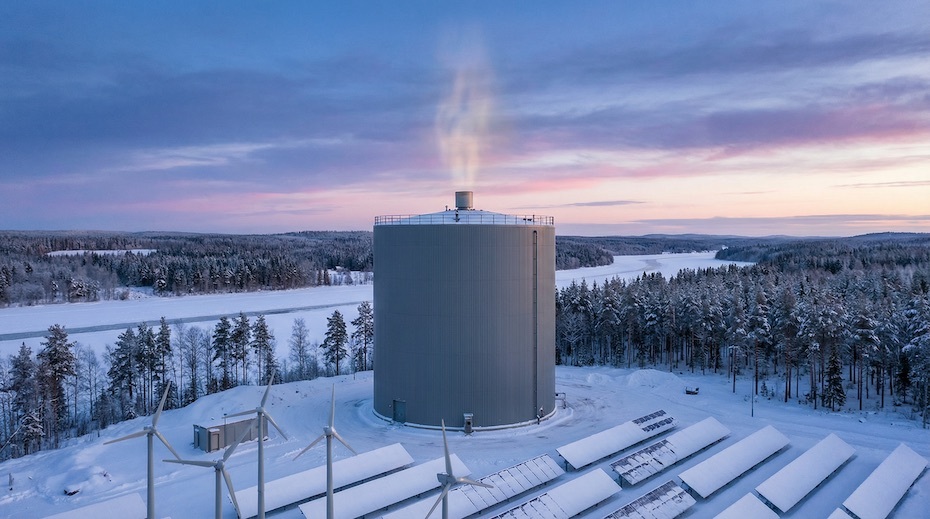
Finland’s sand battery is a breakthrough in long-duration energy storage, using cheap, abundant sand to store renewable energy as high-temperature heat for weeks at a time, providing a cost-effective and scalable solution to the intermittency of solar and wind power.
As you navigate the transition to a cleaner energy future, the greatest challenge you face isn’t just generating renewable energy—it’s storing it. The sun doesn’t always shine, and the wind doesn’t always blow, creating a fundamental intermittency problem that has held back the full potential of renewables. For decades, the industry has searched for a cost-effective, scalable, and long-duration energy storage solution. Now, from the small towns of Finland, a surprisingly simple yet powerful answer has emerged: the sand battery. This technology, pioneered by Polar Night Energy, is not just a novel concept; it’s a commercially operating, game-changing solution that is already decarbonizing district heating networks and proving its economic viability. This article provides a data-driven analysis of why this humble material is poised to become a cornerstone of the global energy transition.
The Achilles’ Heel of the Energy Transition: The Storage Problem
Your journey toward a fully renewable energy grid is fundamentally a battle against time. You can generate vast amounts of clean electricity when the sun is high and the wind is strong, but what happens when clouds roll in or the air becomes still? This intermittency is the Achilles’ heel of the renewable energy revolution. Without a way to store massive amounts of energy for hours, days, or even weeks, you remain tethered to fossil fuels to fill the gaps, undermining your decarbonization goals and leaving you exposed to volatile energy prices.
For years, lithium-ion batteries have been the default solution, but they are far from a silver bullet. While effective for short-duration storage (typically 1-4 hours), they are prohibitively expensive for long-duration applications, have a limited lifespan, and rely on supply chains fraught with geopolitical and environmental risks. The global energy transition requires a portfolio of storage solutions, and for long-duration storage—the key to unlocking a 100% renewable grid—a different approach is needed.
This is where thermal energy storage (TES) comes in. Instead of storing electricity in chemical form, TES systems store it as heat in a low-cost medium. The global thermal energy storage market is projected to grow from $6.5 billion in 2025 to over $17 billion by 2035, a clear indicator of its rising importance [1]. Within this burgeoning market, Finland’s sand battery stands out for its simplicity, scalability, and stunningly low cost.
The Data-Driven Case for a New Storage Paradigm
To appreciate the disruptive potential of the sand battery, you need to look at the numbers. The table below compares key metrics for various energy storage technologies. The data makes it clear why a solution like the sand battery is not just an incremental improvement, but a paradigm shift.
| Metric | Sand Battery (Polar Night) | Lithium-Ion Battery | Pumped Hydro Storage | Compressed Air Storage | Molten Salt Storage |
| Cost per kWh | $25 | $115 | $150 | $80 | $50 |
| Storage Duration | Weeks to Months | 1-4 Hours | Days to Weeks | Hours to Days | Hours |
| Lifespan | 30+ Years | 10-15 Years | 50+ Years | 30+ Years | 20+ Years |
| Round-Trip Efficiency | 75% (Heat) | 85-95% (Electricity) | 70-85% (Electricity) | 40-70% (Electricity) | 90% (Heat) |
| Scalability | High (Modular) | Moderate | Low (Geographically Limited) | Moderate (Geologically Limited) | Moderate |
| Material Scarcity | Very Low (Sand, Steel) | High (Lithium, Cobalt) | Low | Moderate | Moderate |
Sources: [2], [3], [4]
As the data shows, the sand battery’s cost is its most compelling feature—at $25/kWh, it is nearly five times cheaper than lithium-ion technology. This dramatic cost reduction fundamentally changes the economics of grid-scale storage.
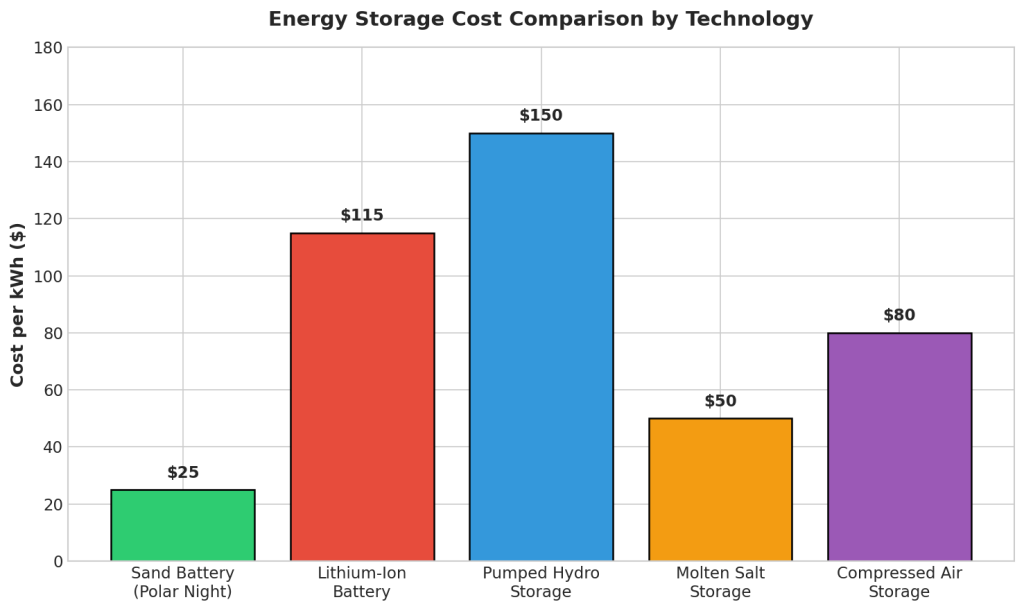
Energy Storage Cost Comparison by Technology
But cost is only part of the story. The sand battery’s ability to store energy for weeks at a time directly addresses the long-duration storage challenge, providing a buffer against prolonged periods of low renewable generation. This capability is something that lithium-ion batteries simply cannot provide economically. While pumped hydro offers long-duration storage, it is geographically constrained to mountainous regions, limiting its widespread applicability. The sand battery, in contrast, can be built almost anywhere.
How It Works: The Elegant Simplicity of the Sand Battery
At its core, a sand battery is a large, insulated steel silo filled with a low-cost, solid material—typically sand, crushed soapstone, or other industrial byproducts. The concept is elegantly simple, yet the engineering behind it is sophisticated. Here’s how it works:
- Charging: Excess electricity from the grid—ideally cheap, abundant renewable energy—is used to power a resistive heater. This heater raises the temperature of air, which is then circulated through a network of pipes within the sand-filled silo. The sand absorbs the heat, reaching temperatures of 500-600°C (932-1112°F).
- Storage: The insulated silo minimizes heat loss, allowing the sand to retain its thermal energy for weeks or even months. The storage efficiency is remarkably high, with some sources claiming up to 99% of the heat can be retained over long periods [5].
- Discharging: When heat is needed, cool air is circulated back through the pipes. The hot sand heats the air, and this hot air is then used to heat water for a district heating network, generate steam for industrial processes, or even produce electricity via a turbine (though with lower efficiency).
This process is controlled by a fully automated system that monitors electricity prices, charging the battery when power is cheap and discharging when it is most valuable. The use of a common, inert material like sand means the system has a design life of 30+ years with minimal degradation, a stark contrast to the 10-15 year lifespan of lithium-ion batteries.
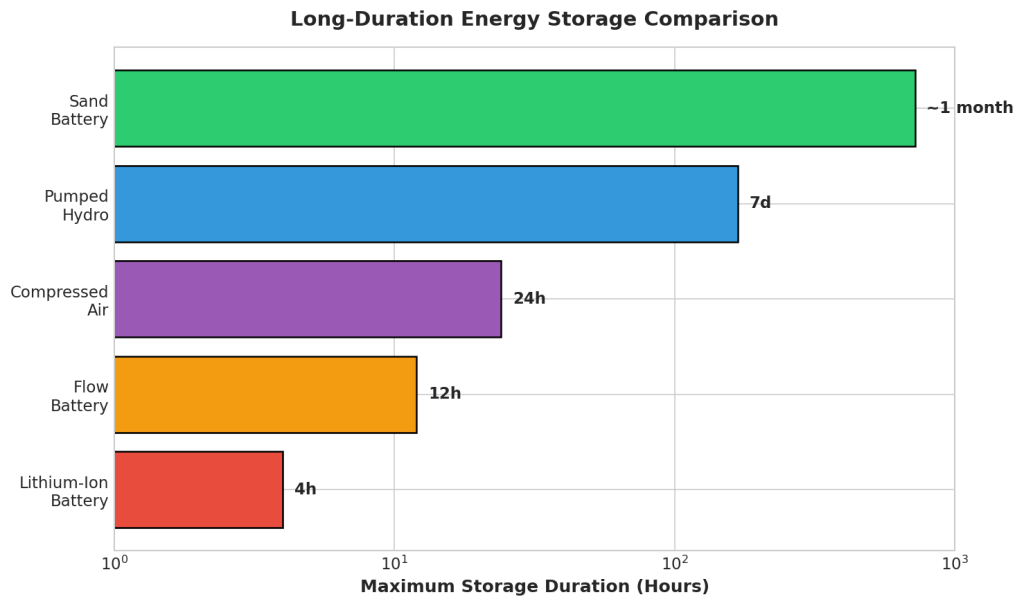
Long-Duration Energy Storage Comparison
Why Sand?
The choice of sand as a storage medium is a masterstroke of practical engineering. Sand is:
- Abundant and Cheap: It is one of the most common materials on Earth, making the core of the battery incredibly inexpensive.
- High Thermal Capacity: Sand can store a large amount of heat in a small volume.
- High Temperature Tolerance: It can be heated to very high temperatures without degrading, allowing for efficient heat transfer.
- Non-Toxic and Non-Flammable: Unlike the materials in chemical batteries, sand poses no environmental or fire risk.
This combination of properties makes sand an ideal medium for large-scale, low-cost thermal energy storage.
Case Studies in Action: From Pilot to Grid-Scale Dominance
The sand battery is not a theoretical concept; it is a proven technology that is already delivering results in Finland. The rapid evolution from a small pilot to a massive grid-scale project demonstrates the technology’s scalability and commercial viability.
1. The World’s First – Kankaanpää (2022)
In 2022, Polar Night Energy launched the world’s first commercial sand battery in Kankaanpää, a town in western Finland. This pioneering project, developed for the energy utility Vatajankoski, served as a crucial proof of concept.
| Metric | Kankaanpää Sand Battery |
| Heating Power | 200 kW |
| Storage Capacity | 8 MWh |
| Size | 4m wide, 7m high |
| Storage Medium | ~100 tons of sand |
| Application | Priming waste heat from data servers for district heating |
Source: [6]
The Kankaanpää battery takes 60°C waste heat from data centers and boosts it to the 75-100°C required for the local district heating network. This innovative use of waste heat, combined with the ability to store cheap renewable energy, allowed Vatajankoski to reduce its reliance on more expensive and carbon-intensive heat sources. The project was a resounding success, meeting all performance criteria and achieving an overall efficiency of 60-75% [6].
2. The World’s Largest – Pornainen (2025)
Building on the success of the Kankaanpää pilot, Polar Night Energy launched the world’s largest sand battery in Pornainen in June 2025. This project, ten times larger than the first, is a major step toward grid-scale deployment.
| Metric | Pornainen Sand Battery |
| Heating Power | 1 MW |
| Storage Capacity | 100 MWh |
| Size | 49 ft wide silo |
| Storage Medium | 2,000 metric tons of crushed soapstone |
| Application | Decarbonizing the town’s district heating network |
Source: [2]
The Pornainen battery is projected to slash the town’s carbon emissions by 70%, reducing the consumption of wood chips by 60% and eliminating the use of costly fuel oil [2]. The use of crushed soapstone, a waste product from a local fireplace manufacturer, further enhances the project’s sustainability and circular economy credentials.
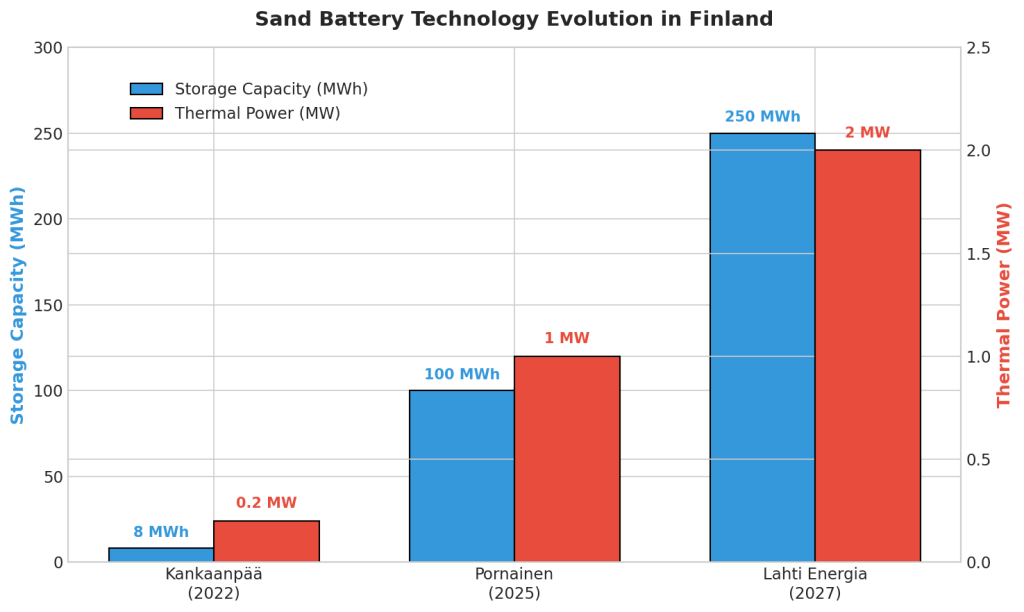
Sand Battery Technology Evolution in Finland
The Next Leap: Lahti Energia (2027)
The evolution continues. In late 2025, Lahti Energia, a major Finnish utility, announced plans to build a 250 MWh sand battery in Vääksy, set for completion in 2027. This project will be the largest of its kind in the world and will not only provide clean heat but also participate in Finland’s grid balancing markets, providing a new revenue stream and enhancing grid stability [7]. This move by a major utility signals the sand battery’s transition from a niche innovation to a mainstream energy asset.
The Economic and Environmental Imperative: A Data-Driven Impact Analysis
The adoption of sand battery technology is driven by a powerful combination of economic incentives and environmental benefits. For energy providers and industrial users, the business case is just as compelling as the climate case.
Decoupling from Volatile Fuel Prices
One of the most significant advantages of the sand battery is its ability to decouple heat production from volatile fossil fuel markets. By storing energy when it is cheap and abundant, you can avoid purchasing expensive natural gas or fuel oil during peak demand periods. This is particularly crucial in Europe, where natural gas prices have seen extreme volatility. Finland’s electricity, at €0.08/kWh, is already the cheapest in Europe, and the ability to time-shift its use further enhances the economic advantage [2].
A New Revenue Stream: Grid Services
The Lahti Energia project highlights a critical, and often overlooked, revenue stream for sand batteries: grid services. As the share of intermittent renewables on the grid grows, so does the need for ancillary services like frequency regulation and grid balancing. Sand batteries, with their ability to rapidly absorb or discharge large amounts of energy (as heat), are perfectly suited to provide these services. This allows you to not only save money on your own energy costs but also to earn revenue by helping to stabilize the grid.
The Environmental ROI: Deep Decarbonization
The environmental return on investment is just as impressive. The Pornainen and Lahti Energia projects are projected to reduce CO₂ emissions from their respective district heating networks by 60-70% [2, 7]. This is not incremental progress; it is a giant leap toward decarbonization.
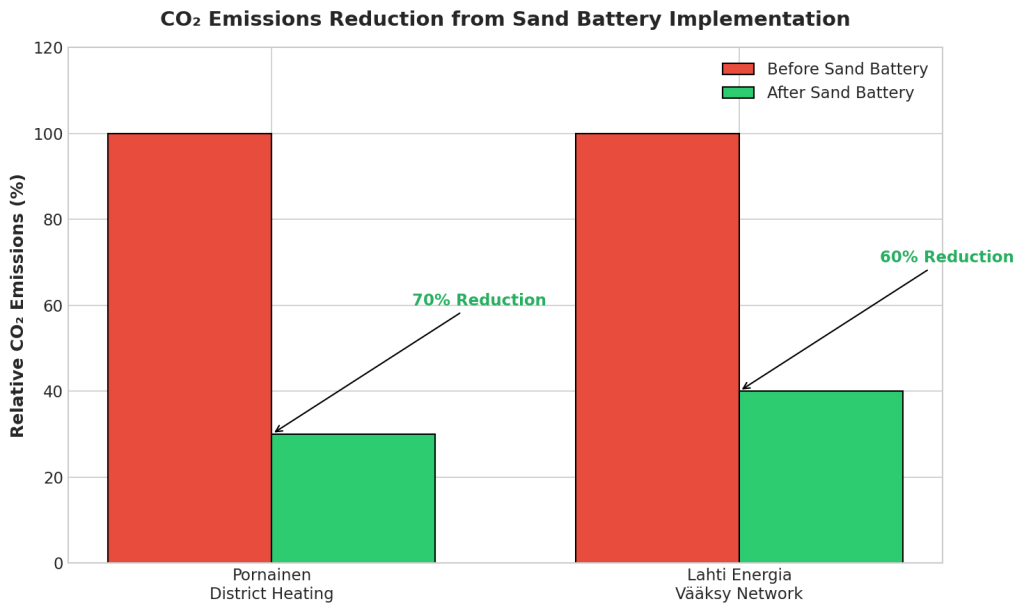
CO₂ Emissions Reduction from Sand Battery Implementation
By replacing the combustion of fossil fuels and even biomass with stored renewable heat, sand batteries offer a clear and immediate path to cleaner air and a more stable climate. This is particularly important for the district heating sector, which is responsible for a significant portion of Europe’s energy consumption and emissions.
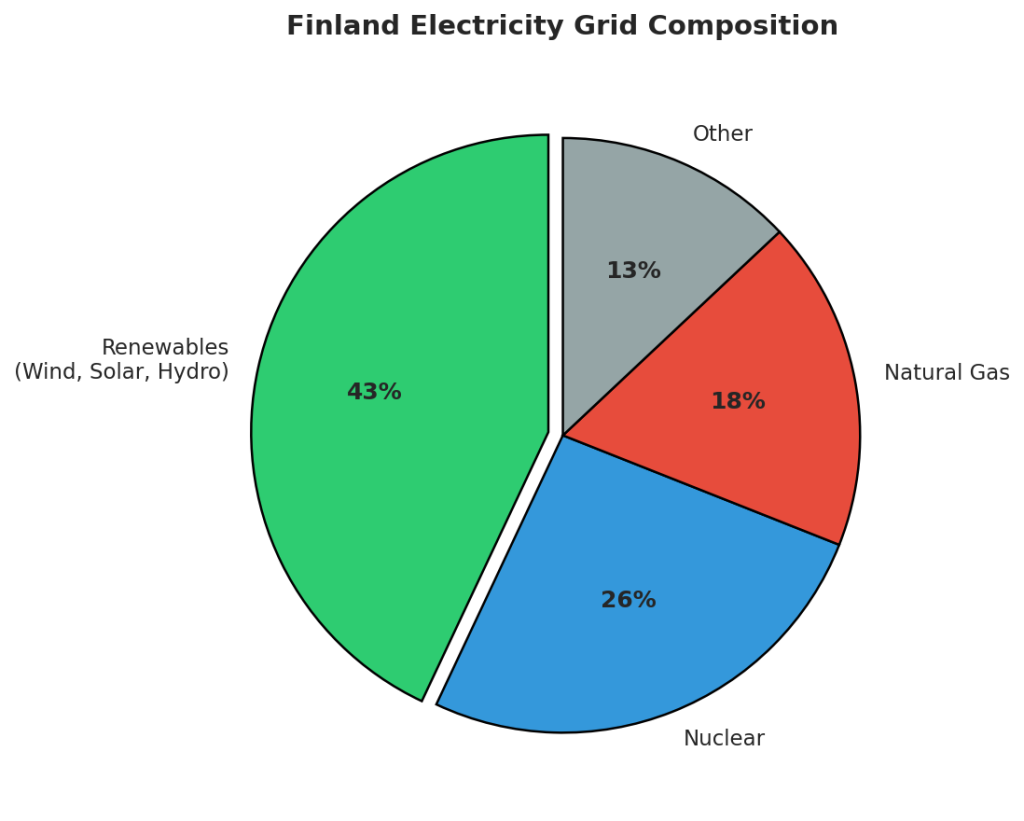
Finland Electricity Grid Composition
Finland’s clean grid, with 43% renewables and 26% nuclear, provides a low-carbon source of electricity to charge the sand batteries, creating a virtuous cycle of decarbonization [2]. As you can see, Finland is well-positioned to leverage this technology for maximum environmental impact.
Original Analysis: The Sand Battery Decision Matrix
For energy executives, industrial plant managers, and municipal planners, the question is not whether to invest in energy storage, but which technology offers the best fit for your specific needs. This decision matrix provides a framework for evaluating the sand battery against other storage options based on your primary objectives.
| Primary Objective | Sand Battery | Lithium-Ion | Pumped Hydro | Compressed Air | Molten Salt |
| Lowest Capital Cost | ★★★★★ | ★★☆☆☆ | ★☆☆☆☆ | ★★★☆☆ | ★★★★☆ |
| Long-Duration Storage (>24h) | ★★★★★ | ★☆☆☆☆ | ★★★★☆ | ★★★☆☆ | ★★☆☆☆ |
| Grid-Scale Heat Production | ★★★★★ | ★☆☆☆☆ | ☆☆☆☆☆ | ★★☆☆☆ | ★★★★☆ |
| High Round-Trip Efficiency (Electricity) | ★★☆☆☆ | ★★★★★ | ★★★★☆ | ★★★☆☆ | ★☆☆☆☆ |
| Geographic Flexibility | ★★★★★ | ★★★★★ | ★☆☆☆☆ | ★★☆☆☆ | ★★★★☆ |
| Environmental/Supply Chain Risk | Low | High | Low | Low | Moderate |
How to Use This Matrix:
- If your primary need is low-cost, long-duration thermal energy for district heating or industrial processes, the sand battery is the clear winner. Its combination of low capital cost, long storage duration, and geographic flexibility is unmatched.
- If you require high-efficiency, short-duration electricity storage for applications like peak shaving or frequency regulation, lithium-ion batteries remain a strong contender. However, you must weigh this against their higher cost and supply chain risks.
- If you have the right geography, pumped hydro is an excellent option for very large-scale, long-duration electricity storage. Its limitations are purely geographical.
- Molten salt is a mature technology for thermal storage, particularly in concentrated solar power applications. It is more expensive than sand but offers high efficiency for heat-to-power conversion.
Your optimal strategy will likely involve a portfolio of these technologies, with the sand battery playing a crucial role in providing the low-cost, long-duration thermal storage that has been the missing piece of the puzzle.
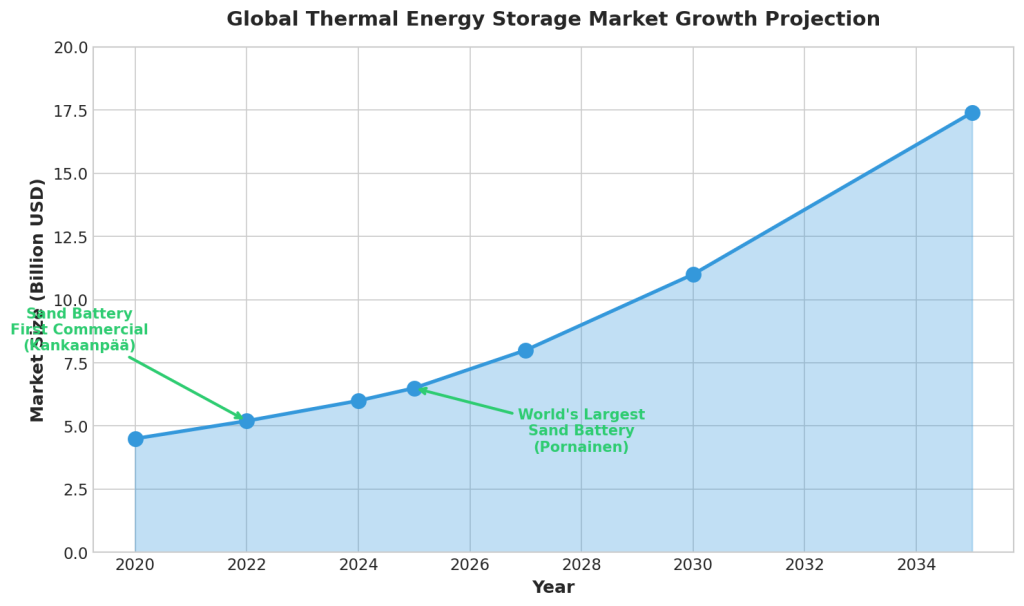
Global Thermal Energy Storage Market Growth Projection
The Global Imperative for Long-Duration Storage
The challenge of storing renewable energy is not unique to Finland; it is a global problem that is becoming more acute as the world races to decarbonize. The International Energy Agency (IEA) has stated that to reach net-zero emissions by 2050, the world will need a staggering 10,000 GWh of energy storage by 2040, a 50-fold increase from today’s levels. A significant portion of this will need to be long-duration storage, capable of dispatching energy for days or weeks.
This is where the limitations of our current energy storage infrastructure become starkly apparent. Lithium-ion batteries, while dominant in the short-duration market, are simply not a viable solution for the long-duration needs of a fully renewable grid. The cost, material constraints, and lifespan limitations make them unsuitable for storing massive amounts of energy for extended periods. This has created a critical gap in the market, a void that technologies like the sand battery are perfectly positioned to fill.
The Spectrum of Storage Technologies
It is crucial to understand that there is no single “best” energy storage technology. The optimal solution depends on the specific application, duration, and cost requirements. The energy storage landscape can be thought of as a spectrum:
- Short-Duration (Seconds to Hours): This is the domain of batteries (lithium-ion, lead-acid) and supercapacitors. They are ideal for applications like frequency regulation, voltage support, and managing short-term fluctuations in renewable generation.
- Medium-Duration (Hours to Days): This is where technologies like flow batteries and compressed air energy storage (CAES) come into play. They can store more energy for longer periods than lithium-ion batteries, but often at a higher cost or with geographical constraints.
- Long-Duration (Days to Seasons): This is the most challenging and underserved segment of the market. It requires technologies that can store vast amounts of energy for weeks or even months at a very low cost. This is the realm of pumped hydro, green hydrogen, and, most promisingly, thermal energy storage systems like the sand battery.
The sand battery’s unique value proposition is its ability to dominate the long-duration thermal energy storage niche at a cost point that other technologies cannot match. This makes it an essential tool for decarbonizing the two most challenging sectors of the energy economy: heating and industry.
The Unseen Giant: Decarbonizing Industrial and District Heat
While much of the public focus on the energy transition is on electricity, the reality is that heating and industrial processes account for a massive share of global energy consumption and CO₂ emissions. In the European Union, heating and cooling in buildings and industry account for 50% of total energy consumption [8]. Decarbonizing this sector is not just an option; it is a mathematical necessity to meet climate targets.
This is where the sand battery’s focus on thermal energy becomes a powerful advantage. Instead of converting stored heat back to electricity at a loss, the sand battery can deliver that heat directly to district heating networks and industrial facilities with very high efficiency. This direct heat application is a far more efficient and cost-effective way to decarbonize these sectors than trying to electrify all heating processes.
The District Heating Revolution
District heating systems, common in Northern and Eastern Europe, are a prime market for sand batteries. These systems use a central plant to generate hot water, which is then piped to thousands of homes and businesses. Currently, many of these plants rely on natural gas, coal, or biomass. By integrating a sand battery, a district heating operator can:
- Absorb cheap renewable electricity from the grid during periods of oversupply.
- Store it as high-temperature heat for weeks at a time.
- Dispatch this clean heat into the network, displacing fossil fuels.
The Pornainen and Lahti Energia projects are perfect examples of this model in action. They are not just storing energy; they are fundamentally transforming the business model of district heating, turning it from a fossil-fuel-dependent utility into a flexible, low-carbon energy service.
The Industrial Heat Challenge
Many industrial processes, such as food production, chemical manufacturing, and pulp and paper, require vast amounts of heat, often at very high temperatures. This heat is typically generated by burning natural gas on-site. The sand battery offers a direct, drop-in replacement for this fossil fuel consumption. An industrial facility can install a sand battery, charge it with low-cost renewable electricity, and use the stored thermal energy to generate the steam and hot air needed for its processes. This not only reduces the facility’s carbon footprint but also insulates it from volatile natural gas prices, providing a significant competitive advantage.
This direct application of thermal energy is a critical and often underestimated aspect of the sand battery’s potential. It is a technology that is perfectly tailored to solve one of the biggest and most difficult challenges of the energy transition.
A Technical Deep Dive: The Engineering Behind the Simplicity
While the concept of heating sand is simple, the successful commercialization of the sand battery is a testament to sophisticated engineering and a deep understanding of thermodynamics, materials science, and control systems. For you, the energy professional, understanding these technical nuances is key to appreciating the technology’s robustness and evaluating its application in your own projects.
The Heart of the System: Heat Transfer and Distribution
The core of the sand battery is its heat transfer system. This is not simply a case of burying a heating element in sand. Polar Night Energy has developed a patented network of pipes and a circulation system that ensures efficient and uniform heat distribution throughout the storage medium. Key engineering considerations include:
- Air as a Medium: The system uses air as the heat transfer fluid. Air is circulated through a closed loop, heated by electric resistors, and then forced through the network of pipes embedded in the sand. This avoids the complexities and potential corrosion issues associated with using liquids like molten salt or thermal oils.
- Pipe Network Design: The layout of the heat transfer pipes is critical. The design must ensure that heat is distributed evenly to prevent hot spots and maximize the usable storage volume. Computational Fluid Dynamics (CFD) modeling is used extensively to optimize this layout for different silo sizes and shapes.
- Minimizing Thermal Stress: Repeatedly heating and cooling materials from ambient temperatures to over 500°C creates significant thermal stress. The choice of materials for the pipes (typically high-grade steel alloys) and the design of the system to allow for thermal expansion and contraction are crucial for ensuring the system’s 30+ year design life.
The Insulating Shell: Holding the Heat for Months
The ability to store heat for weeks or months with minimal loss is what makes the sand battery a true long-duration storage solution. This is achieved through a high-performance insulation system.
| Insulation Layer | Material | Function |
| Inner Layer | High-temperature mineral wool or ceramic fiber | Withstands direct contact with the hot sand and provides the primary thermal barrier. |
| Intermediate Layer | Multiple layers of standard insulation materials | Reduces heat transfer through conduction and convection. |
| Outer Shell | Corrugated steel silo | Provides structural support, weather protection, and a final barrier. |
This multi-layer approach creates a thermal gradient, stepping down the temperature from over 500°C at the core to near-ambient temperatures at the outer shell. The thickness and composition of these layers are optimized based on the size of the battery and the desired storage duration. For larger batteries, the surface-area-to-volume ratio decreases, making them inherently more efficient at retaining heat.
The Brains of the Operation: Automated Control System
The sand battery’s economic viability depends on its ability to charge when electricity is cheapest and discharge when heat is most valuable. This is managed by a sophisticated, fully automated control system. This system continuously monitors:
- Real-time electricity prices from the grid (e.g., Nord Pool spot market).
- The thermal state of the battery at multiple points within the sand.
- The heat demand of the district heating network or industrial process.
- Grid frequency and stability to participate in ancillary service markets.
Based on this data, the control system’s algorithms make autonomous decisions about when to charge, when to discharge, and at what rate. This allows the battery to operate as a fully flexible asset, maximizing its economic return without the need for constant human intervention. This level of automation is critical for scaling the technology and integrating it seamlessly into complex energy systems.
Beyond Finland: Global Applicability and the Competitive Landscape
While Finland, with its cold climate and established district heating networks, provides the perfect incubator for sand battery technology, its potential is far from limited to the Nordic region. The fundamental principles of the sand battery are universally applicable to any region with a need for low-cost thermal energy and a growing share of renewable electricity. You should be evaluating its potential in a variety of global contexts.
Global Hotspots for Sand Battery Adoption
- Europe: Countries with extensive district heating networks, such as Germany, Poland, Sweden, and the Baltic states, are prime candidates for sand battery deployment to decarbonize their heat supply. The EU’s push to reduce reliance on Russian natural gas provides a powerful geopolitical incentive for this transition.
- North America: In colder regions of the United States and Canada, sand batteries can be integrated with university campuses, hospital complexes, and industrial parks that operate their own heating systems. They can also be a key enabler for new, modern district energy systems in urban redevelopment projects.
- Industrial Hubs: Any industrial region with a concentration of manufacturing that requires process heat—from food and beverage to chemicals and textiles—can leverage sand batteries to reduce costs and emissions. This is particularly relevant in regions with high renewable penetration and volatile electricity prices.
- Arid and Sunny Regions: Ironically, some of the best locations for sand batteries may be hot, sunny deserts. These regions have abundant solar energy and, often, abundant sand. While the need for heating is low, the stored high-temperature heat can be used to power industrial processes or, with further development, be converted to electricity to meet evening demand.
The Competitive Landscape: A Closer Look
The sand battery does not exist in a vacuum. Several other innovative thermal and long-duration storage technologies are vying for market share. Understanding their strengths and weaknesses is crucial for making an informed investment decision.
| Technology | Key Advantage | Key Disadvantage | Best Use Case |
| Sand Battery | Lowest cost, very long duration | Lower heat-to-power efficiency | District heating, industrial process heat |
| Molten Salt | Mature technology, high heat-to-power efficiency | Higher cost, corrosive materials | Concentrated Solar Power (CSP) plants |
| Compressed Air (CAES) | Long duration, uses mature components | Geologically constrained, lower efficiency | Grid-scale electricity storage |
| Flow Batteries | Decoupled power/energy, long cycle life | Higher cost, complex chemistry | Medium-duration grid services |
| Green Hydrogen | Very long (seasonal) storage, versatile fuel | High cost, low round-trip efficiency | Seasonal storage, hard-to-abate sectors |
Sources: [9], [10]
As this comparison shows, the sand battery’s competitive edge is its specialization. It is not trying to be the best at everything. It is designed to be the best at one, critically important thing: providing cheap, long-duration thermal energy. While technologies like green hydrogen may be better for seasonal electricity storage, their high cost and low efficiency make them unsuitable for the bulk heat market that the sand battery targets. Similarly, while flow batteries offer more flexibility for grid services, they cannot compete with the sand battery on the levelized cost of stored energy for heat applications.
Your strategic takeaway should be that the sand battery is not a competitor to all other storage technologies, but a vital and complementary part of a larger energy storage ecosystem. It fills a specific, massive, and previously underserved market niche.
Investment and Policy Implications: Creating the Market for Sand Batteries
For the sand battery to move from a Finnish innovation to a global standard, a supportive ecosystem of investment and policy is required. As a decision-maker in the energy sector, your role is not just to adopt new technologies, but to help shape the market conditions that allow them to thrive. The success of the sand battery will depend on a confluence of smart capital allocation and forward-thinking regulation.
The Investment Case: Beyond Venture Capital
Polar Night Energy has successfully navigated the early stages of startup funding, securing the venture capital needed to build its initial projects. However, the widespread deployment of sand batteries will require a different class of investment. This is a technology that is perfectly suited for infrastructure investors, pension funds, and other sources of patient capital that seek stable, long-term returns.
The investment case for a sand battery project is built on several key pillars:
- Long-Term, Predictable Revenue Streams: A sand battery integrated with a district heating network generates revenue from the sale of heat, often under long-term contracts. Additional revenue can be secured from providing grid services.
- Low Operating Costs: Once built, the operating costs of a sand battery are extremely low. The storage medium (sand) does not degrade, and the main moving parts are fans and pumps, which are mature and reliable technologies.
- Insulation from Fuel Price Volatility: By shifting energy consumption to periods of low electricity prices, the sand battery provides a hedge against the price volatility of natural gas and other fossil fuels, leading to more stable and predictable operating margins.
- ESG (Environmental, Social, and Governance) Appeal: The sand battery is a highly attractive asset for ESG-focused investors. It has a clear and quantifiable environmental benefit, supports community energy resilience (social), and is built on a foundation of transparent and robust engineering (governance).
For you, as an investor or a utility manager seeking project financing, the key is to frame the sand battery not as a speculative technology investment, but as a long-life, low-risk infrastructure asset, similar to a wind farm or a solar park.
The Policy Levers: Accelerating Adoption
Government policy can play a crucial role in accelerating the adoption of sand batteries and other long-duration energy storage technologies. Smart, targeted policies can de-risk investment and create a level playing field where the most effective solutions can compete. Key policy levers include:
- Carbon Pricing: A meaningful price on carbon is the most powerful single policy to accelerate the transition away from fossil-fuel-based heating. By making natural gas and fuel oil more expensive, a carbon tax or emissions trading system makes the business case for sand batteries even more compelling.
- Streamlined Permitting for Energy Storage: In many jurisdictions, the regulatory framework for permitting energy storage projects is complex and slow. Creating a streamlined, technology-neutral permitting process for energy storage can significantly reduce project development timelines and costs.
- Incentives for Decarbonizing Heat: While the economics of sand batteries are already attractive, targeted incentives—such as the energy aid received by Lahti Energia from Business Finland—can help to de-risk early projects and accelerate market development. These could take the form of investment tax credits, production tax credits for clean heat, or grants for innovative projects.
- Market Design for Flexibility: Electricity markets must be designed to properly value flexibility. This means creating markets for ancillary services (like the grid balancing market in Finland) that allow storage assets like the sand battery to be compensated for the grid stability services they provide. Time-of-use electricity rates that reflect the real-time cost of generation also create a strong price signal for charging batteries during periods of low demand and high renewable generation.
By advocating for and implementing these types of policies, you can help to create a market environment where innovative, cost-effective solutions like the sand battery can be deployed at the scale and speed required to meet our climate goals.
Conclusion: The Bedrock of a Renewable Future
Finland’s sand battery is more than just a clever invention; it is a powerful demonstration of how simple, robust, and cost-effective solutions can solve the most complex challenges of the energy transition. By leveraging one of the world’s most abundant materials, Polar Night Energy has created a technology that fundamentally changes the economics of long-duration energy storage. The data is clear: with a cost that is a fraction of lithium-ion, a lifespan measured in decades, and the ability to store energy for weeks, the sand battery is a game-changer.
For you, the energy professional, this technology offers a clear path forward. It provides a way to decouple from volatile fuel prices, create new revenue streams from grid services, and achieve deep decarbonization of your heating and industrial processes. The rapid scaling from a small pilot in Kankaanpää to a massive grid-scale project in Lahti is a testament to the technology’s commercial readiness and the growing market demand for long-duration storage.
As you look to build a resilient, affordable, and sustainable energy system, you must look beyond the hype of more complex technologies and embrace the elegant simplicity of the sand battery. It is not just a Finnish curiosity; it is the bedrock upon which a truly renewable future can be built.
References
[1] The Business Research Company. “Thermal Energy Storage Global Market Report 2025.” https://www.thebusinessresearchcompany.com/report/thermal-energy-storage-global-market-report
[2] TechCrunch. “Finland warms up the world’s largest sand battery, and the economics look appealing.” https://techcrunch.com/2025/06/16/finland-warms-up-the-worlds-largest-sand-battery-and-the-economics-look-appealing/
[3] National Renewable Energy Laboratory (NREL). “Cost Projections for Utility-Scale Battery Storage: 2025 Update.” https://docs.nrel.gov/docs/fy25osti/93281.pdf
[4] ScienceDirect. “Benchmarking thermal energy storage cost for industrial process heat.” https://www.sciencedirect.com/science/article/pii/S0306261925016034
[5] Polar Night Energy. “Sand Battery.” https://polarnightenergy.com/sand-battery/
[6] Polar Night Energy. “World’s first Sand Battery.” https://polarnightenergy.com/reference/worlds-first-sand-battery/
[7] Polar Night Energy. “Lahti Energia Invests in a Sand Battery – Towards Climate-friendly and Cost-efficient Energy.” https://polarnightenergy.com/news/lahti-energia-invests-in-a-sand-battery-towards-climate-friendly-and-cost-efficient-energy/
[8] Euroheat & Power. “New study finds district energy networks will lead Europe’s heating and cooling decarbonisation by 2050.” https://www.euroheat.org/press-releases/new-study-finds-district-energy-networks-will-lead-europe-s-heating-and-cooling-decarbonisation-by-2050
[9] C&EN. “The search for long-duration energy storage.” https://cen.acs.org/energy/energy-storage-/search-long-duration-energy-storage/103/i5
[10] TIME. “Polar Night Energy Sand Battery – Best Inventions of 2025.” https://time.com/collections/best-inventions-2025/7318348/polar-night-energy-sand-battery/

Lee Fondiller is a seasoned operations executive with over 20 years of experience in technology and sustainability. As COO of Solar4Pools, he leads innovation in the renewable energy industry with a focus on solar-powered solutions.