
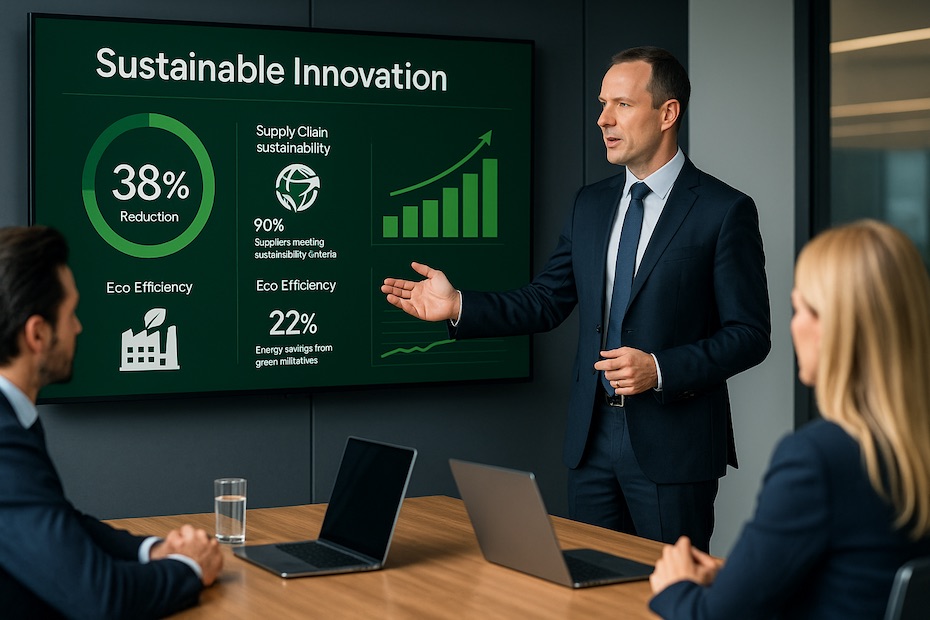
You gain a competitive edge by embedding sustainability into innovation across products, operations, and supply chains—creating measurable value beyond compliance or image.
This article shows how sustainability-led innovation helps you cut costs, grow market share, win investor trust, and secure long-term leadership. You’ll learn how to apply innovation to drive financial and environmental performance simultaneously.
1. Cut Operating Costs Through Resource Efficiency
Reducing energy, water, and material waste gives you an immediate advantage.
When you redesign processes to be more energy- or resource-efficient, you reduce variable costs while improving productivity. In the EU, firms that adopted eco-innovation strategies reported cost savings of up to 20% in manufacturing inputs within two years. Businesses that shifted to closed-loop systems—like recycling in production or on-site solar generation—cut costs while boosting ESG scores.
These savings compound over time. A food packaging company reduced material use by 18% using lightweight design. That not only cut raw material expenses but also decreased logistics and emissions—creating a leaner, more resilient business.
2. Differentiate Your Brand and Build Trust
Sustainability strengthens your market position by creating unique value.
Consumers increasingly choose brands that reflect their values. McKinsey data shows over 60% of U.S. consumers pay more for sustainable products, while Gen Z buyers actively reward climate-conscious companies. That means you gain market share by being more transparent and innovative in how you solve environmental problems.
One beauty brand captured massive loyalty by switching to refillable containers and publishing full lifecycle emissions of every product. Their environmental innovation became a clear competitive advantage that pulled customers away from legacy competitors still relying on plastic and opaque supply chains.
3. Access Capital and Regulatory Advantage
Sustainable innovation aligns with global capital flows and compliance expectations.
Investors now evaluate companies based on ESG (Environmental, Social, Governance) performance. If your products are designed for lower impact, or your operations reflect traceable environmental benefits, you’ll attract better financing. ESG-focused funds grew to over $2.5 trillion globally in 2024, and large institutions prioritize portfolios with green innovation credibility.
In parallel, regulatory bodies worldwide offer incentives, tax breaks, and procurement preferences for sustainable businesses. When your innovation aligns with decarbonization and green transition goals, you’ll be better positioned for government grants and preferred supplier lists.
4. Strengthen Your Supply Chain and Partnerships
Sustainability drives supply-side innovation and resilience.
When you innovate with sustainability in mind, your entire supply chain becomes more agile and future-proof. Companies that integrate traceable materials, eco-certifications, and transparent sourcing into their logistics gain buyer trust and reduce risk exposure. This also encourages strategic supplier collaboration, leading to faster adaptation and co-innovation.
For instance, a clothing manufacturer that introduced regenerative cotton across its supply base not only reduced environmental impact, but also won exclusive partnerships with retailers seeking verified sustainable sourcing. That innovation fortified supply chain loyalty and created upstream differentiation.
5. Create Lasting Product and Market Differentiation
Eco-innovation gives you long-term uniqueness in products and business models.
You outperform when you launch products that solve environmental challenges in new ways—whether through circularity, modularity, or material substitution. Tesla didn’t just electrify vehicles—it redesigned manufacturing, supply contracts, and customer experience around sustainability. The result: durable, defensible market leadership.
Even at the SMB level, eco-friendly product innovation leads to new market segments. A home goods company replaced petroleum-based foam with algae-derived cushions, carving out a unique niche in health-conscious furniture. That became a licensing opportunity, an IP asset, and a brand-defining feature—all from sustainability-focused R&D.
Practical Takeaways That Deliver Competitive Edge
- Use circular design to lower cost and reduce waste
- Publicize your impact data—don’t rely on generic claims
- Align with ESG-focused investors and procurement channels
- Embed innovation into your supplier ecosystem
- Patent sustainable features and own your green niche
How does sustainable innovation provide a competitive edge?
- Lowers costs through efficiency
- Wins customers with credible ESG values
- Attracts ESG-focused investment
- Builds supply chain resilience
- Unlocks product differentiation
In Conclusion
You secure an edge when sustainability drives your innovation process. Whether you’re reducing input costs, opening new markets, or building stakeholder trust, sustainability isn’t a constraint—it’s your catalyst for smarter design, stronger partnerships, and long-term resilience. Embed it into how you solve problems, and you’ll outperform those who treat it as a branding exercise.

Lee Fondiller is a seasoned operations executive with over 20 years of experience in technology and sustainability. As COO of Solar4Pools, he leads innovation in the renewable energy industry with a focus on solar-powered solutions.